Stars of the Galaxy
The stars of the Galaxy come in hundreds of forms, from tiny brown dwarfs to massive stars like UY Scuti. The Hertzsprung-Russell Diagram (or HR Diagram) is humanity's best attempt to categorize all observed stars into groups for ease of classification and study. The two axes of this diagram are temperature and luminosity.
Most stars that you and your crew will encounter will fall into seven temperature categories that range from warmest to coolest: O (blue), B (blue-white), A (white), F (yellow-white), G (yellow), K (orange), M (red). Each of these categories is sub-divided into ten fractional numbers to show where in that code the star falls. Sol, our Sun, is a G2 star, thus it is on the warmer end of yellow G-class stars while the primary star of 61 Cygni (the home system of the Tellarites) is a K5 star, in the middle of the orange K class stars. Other temperature categories include L (cool reds), Y (brown dwarfs), C (Carbon Stars), and D (White Dwarfs) to name but a few. Hotter stars tend to burn quickly and have short lifespans measured in as little as millions of years, and cold red stars burn slowly and can possibly have lifespans reaching trillions of years.
The second axis on the HR Diagram is luminosity. Stars can be split into 7 general categories (with other sub-categories left out for sake of clarity): I (Super-giants), II (Bright Giants), III (Giants), IV (Sub-Giants), V (Main-Sequence), and VI (Sub-Dwarfs), and VII / WD (White Dwarfs). Most stars in the Galaxy are Main Sequence (V) and fuse hydrogen at their cores to produce energy. The Sun is a G2V. Sub-Dwarfs (VI) are similar to Main Sequence stars, but typically have less heavy elements (greater atomic mass than helium) than Main Sequence and thus burn cooler than Main Sequence. Main Sequence stars tend to be stable, and thus provide planets around them with relatively greater opportunities for life to evolve.
The luminosity classes brighter than the Main Sequence (Super-Giants, Bright Giants, Giants, and Sun Giants) nearly always involves stars that have begun to age out of the Main Sequence. As stars get older they expand as they cool. This expansion, and greater surface area of the star, is what allows these stars to become so bright. Worlds around these stars tend to be lifeless or show the signs of previous life. As these stars are so luminous, radiation can prove to be an extreme hazard around them even for the most well shielded science vessel. As these stars continue to age they will either form a nova or supernova (see The Dangers of Space below). Some examples of these brighter stars include: Pollux (K0III, or an Orange Giant), Rasalgethi (M5Ib, or a Red Supergiant), and Rigel (B8Ia, or a Blue Supergiant).
Hertzsprung-Russell Diagram
The Hertzsprung-Russell Diagram plots the spectral class or temperature of stars against their absolute magnitude (brightness or luminosity). About 90% of the stars in our galaxy can be found on the Main Sequence, and remain there during their long lifetime of burning hydrogen. When a star has used up all of the hydrogen in its core, it leaves the main sequence and becomes a red giant (upper right); very massive stars may become red supergiants.

Spectral Classes
Each spectral class is divided into 10 subclasses, ranging from 0 (hottest) to 9 (coolest). Stars are also divided into six categories according to luminosity: 1a (most luminous supergiants), 1b (less luminous supergiants), II (luminous giants), III (normal giants), IV (subgiants), and V (main sequence dwarfs). For instance, Sol is classified as G2V, which means that is a relatively hot G-Class main sequence star. In addition, classes R, N, S, T, Q, and W are used for relatively rare star types not found on the main sequence.
Class O – Blue
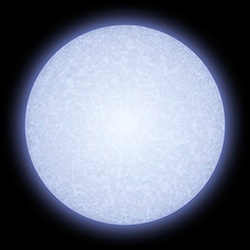
- Temperature: 28,000-50,000° K
- Composition: Ionized atoms, especially helium
- Example: Mintaka (O1-3III)
Class B – Blue-White
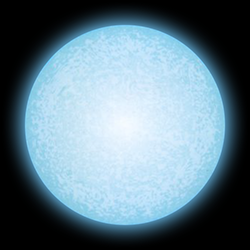
- Temperature: 10,000-28,000° K
- Composition: Neutral helium, some hydrogen
- Example: Alpha Eridani A (B3V-IV)
Class A – White
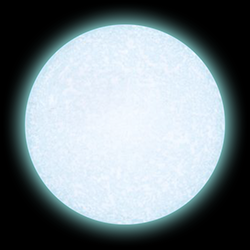
- Temperature: 7,500-10,000° K
- Composition: Strong hydrogen, some ionized metals
- Example: Sirius A (A0-1V)
Class F – Yellow-White
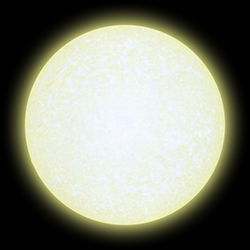
- Temperature: 6,000-7,500° K
- Composition: Hydrogen and ionized metals, calcium and iron
- Example: Procyon A (F5V-IV)
Class G – Yellow
- Temperature: 5,000-6,000° K
- Composition: Ionized calcium, both neutral and ionized metals
- Example: Sol (G2V)
Class K – Orange

- Temperature: 3,500-5,000° K
- Composition: Neutral metals
- Example: Alpha Centauri B (K0-3V)
Class M – Red

- Temperature: 2,500-3,500° K
- Composition: Ionized atoms, especially helium
- Example: Wolf 359 (M5-8V)