Planetary Classes
One or more planets surround most stars, and every one of these worlds is utterly unique. All Starfleet personnel should keep in mind that each new world they encounter has the potential to be deadly and, at the same time, home to secrets found nowhere else. However, it is also important to remember that the vast majority of these millions of planets fall into one of a relatively small number of types. All Class J gas giants are relatively similar, as are all Class D planetoids. The following list describes the eight most common classes of planets. Other types of planets exist, but are sufficiently rare or idiosyncratic to defy any type of standard classification. The standard planetary types are:
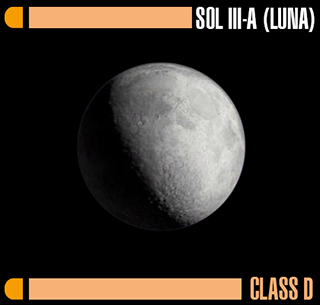
Class D
Class D worlds are the most common planetary bodies, and exist in almost every stellar system. They are all relatively small, airless moons and asteroids that are essentially barren balls of rock. Earth's moon, Luna, is a typical example of such worlds. Almost all of these worlds are lifeless, although a few are home to vacuum-dwelling life or life-forms that live in subsurface cavern complexes. While typically useless for any purpose except mining, some of the larger Class D worlds, like the Andorian world of Weytahn, can be terraformed.
- Diameter: 100-1,000 km
- Surface: Barren and cratered
- Atmosphere: None or very tenuous
- Average Gravity: Negligible to 1G, most are between 0.05 and 0.5 G.
- Dangers: Deadly atmosphere (vacuum), hazardous, hostile, or deadly temperatures, hazardous or hostile radiation.
Class H
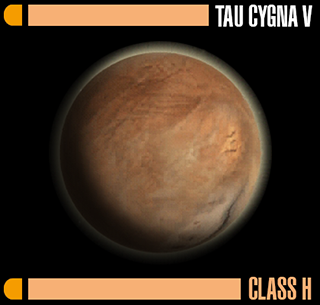
These are hot, dry terrestrial planets, which have little surface water or ice and are, at best, marginally habitable by humanoids. Although some Class H worlds have oxygen-argon atmospheres, many have atmospheres that are mildly poisonous, making long-term survival impossible. Humanoid colonies have been established on Class H worlds, but they rarely thrive.
- Diameter: 8,000-15,000 km
- Surface: Hot and arid, little or no surface water
- Atmosphere: May contain heavy gases and metal vapors
- Average Gravity: 0.5 to 1.5 Gs.
- Dangers: Hazardous or hostile temperatures, possibly hazardous atmospheres.
CLass J
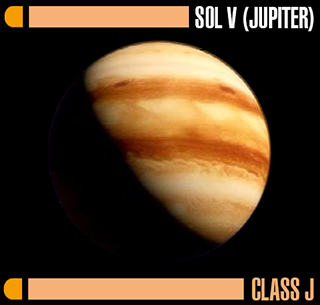
Class J worlds are the most common gas giant planets found. These are large worlds that are typically between 3 and 15 times Earth's diameter that have enormous and dense atmospheres primarily composed of either methane (on smaller Class J planets) or hydrogen (on larger Class J planets) and their surface is almost impossible to reach due to the size and density of their atmospheres. No Class J planet is habitable by humanoids and they are impossible to terraform. However, some have their own entirely airborne alien ecosystems and may even be home to exceptionally alien and intelligent creatures. Class J planets can be found anywhere in a star system, from intensely hot worlds close to their primary to distant frozen worlds. Some Class M planets orbit Class J worlds as moons.
- Diameter: 50,000-140,000 km
- Surface: Tenuous, comprised of gaseous hydrogen and hydrogen compounds; radiates some heat
- Atmosphere: Zones vary in temperature, pressure and composition
- Average Gravity: 0.8 to 3 Gs.
- Dangers: Deadly atmosphere, hazardous, hostile, or deadly temperatures, possibly hazardous, hostile, or deadly radiation.
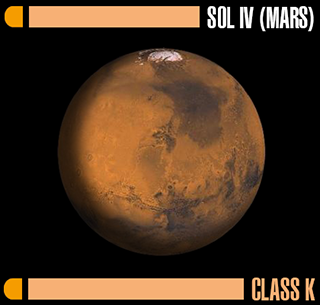
Class K
These frigid worlds include a relatively broad range of planets, from cold, dry worlds like Mars, which typically possess relatively thin carbon dioxide atmospheres, to somewhat larger planets that resemble Saturn's moon Titan or smaller versions of Uranus and Neptune. These frigid worlds have denser atmospheres of methane and nitrogen. These worlds are not gas giants, because they all possess a solid surface, but none are habitable without extensive terraforming and the coldest are simply too hostile to terraform.
- Diameter: 5,000-10,000 km
- Surface: Barren, little to no surface water
- Atmosphere: Thin, mostly carbon dioxide
- Average Gravity: 0.25 to 2 Gs.
- Dangers: Deadly atmosphere, hostile or deadly temperatures, possibly hazardous or hostile radiation.
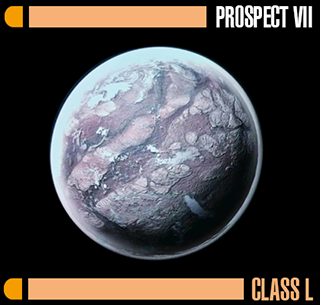
Class L
Class L worlds are marginally habitable planets which contain limited vegetation, but no animal life on land. Most are primitive worlds where life recently evolved and animals have not yet developed the ability to live on land. However, some are simply marginally habitable worlds where land animals cannot survive. Most have atmospheres composed of argon and oxygen, and many have sufficient atmospheric carbon dioxide to cause most humanoids at least mild distress. On some Class L worlds, carbon dioxide levels are sufficiently high enough to slowly poison humanoids.
- Diameter: 10,000-15,000 km
- Surface: Rocky and barren, little surface water
- Atmosphere: Oxygen/argon, high concentration of carbon dioxide
- Average Gravity: 0.5 to 1.5 Gs.
- Dangers: Possibly hazardous atmosphere, possibly hazardous or hostile temperatures, possibly hazardous \ radiation.
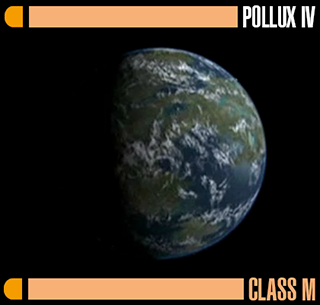
Class M
Class M planets are easily habitable by all humanoids, including Humans, Vulcans, Klingons, Andorians, and many others. These worlds possess oxygen atmospheres and a range of temperatures and pressures that allow liquid water to exist over most of their surface. However, this does not mean that the entire surfaces of these planets are pleasant or even survivable. Much of Vulcan is a desert and some Class M worlds are in the midst of frigid ice ages, where ice sheets a kilometer thick cover more than half their land area. However, all offer locations where humanoid life-forms can thrive with only minimal technology. As a result, the Federation is always looking for uninhabited Class M planets to colonize. Every uninhabited Class M planet you discover may eventually become home to a thriving Federation colony.
Nevertheless, do not forget that even Class M planets can be lethal. In addition to regions that are burning hot or freezing cold, all Class M planets are home to robust ecosystems of animals and plants with biochemistries that are all somewhat similar. As a result, virulent diseases, poisonous or possibly carnivorous plants, and deadly predators can be found on many Class M planets. Starfleet has placed more than a few such worlds off limits for colonization because one or more life-forms were simply too deadly.
- Diameter: 10,000-15,000 km
- Surface: Surface water abundant; if water or ice covers more than 80% of surface, planet is considered Class-O or Class-P
- Atmosphere: Nitrogen, oxygen, trace elements
- Average Gravity: 0.5 to 1.5 Gs.
- Dangers: Localized hazardous or hostile temperatures, possibly localized hazardous or hostile radiation.
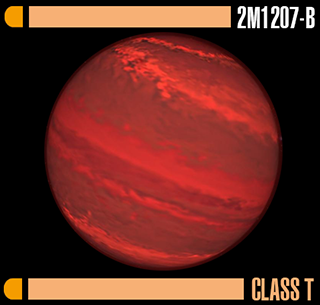
Class T
These planets are a variety of large gas giant, typically much more massive than Class J worlds. Class T planets are the largest and most massive objects classified as planets, and there remains lively debate surrounding the point where a body is too large to be considered a Class T planet and is instead classified as a brown dwarf star. Some Class T worlds are as much as a dozen times the size of the largest Class J world. Gas giants only remain this large when they have not yet finished forming. The largest Class T worlds are a hallmark of a very young stellar system. All Class T planets possess exceedingly high gravity and pressure. Even a brief artificial gravity failure can incapacitate the crew of a starship in the upper atmosphere of a Class T planet, and venturing deeper than the upper atmosphere of such a world can exceed the structural integrity of almost any starship. Also, they are only found in exceedingly young star systems, which abound with asteroids, dark matter, strong stellar flares, and many other dangers rarely found in older star systems.
- Diameter: 50-120 million km
- Surface: Tenuous, composed of gaseous hydrogen and hydrogen compounds; radiated considerable heat
- Atmosphere: Zones vary in temperature, pressure and composition; water vapor may be present
- Average Gravity: 2 to 10 Gs.
- Dangers: Deadly atmosphere, hazardous, hostile, or deadly temperatures, possibly hazardous, hostile, or deadly radiation.
Class Y
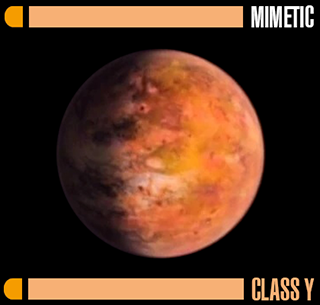
Sometimes called “demon planets,” Class Y worlds are noted for dense, toxic, highly corrosive atmospheres, surface temperatures that exceed 200 C, and periodic thermionic radiation discharges. These radiation discharges mean that even entering a low orbit around a Class Y world can be hazardous. In addition, both the radiation and dense clouds that surround all Class Y worlds limit the utility of sensor scans from orbit. Because of the multitude of dangers Class Y worlds present, Starfleet considers them to be the terrestrial planets least hospitable to humanoid life. They are almost instantly fatal to unprotected humanoids, and space suits, probes, and even starships must all be protected by specially modified shields in order to survive the thermionic radiation.
- Diameter: 10,000-50,000 km
- Surface: Temperature can exceed 500°K
- Atmosphere: Turbulent, saturated with toxic chemicals and thermionic radiation
- Average Gravity: 0.5 to 1.5 Gs.
- Possible Threats: Deadly atmosphere, deadly temperatures, deadly radiation.
Anomalous Worlds
While most worlds fall into one of the above standard types, a few do not, and these planets are, by definition, worthy of further investigation. There are many reasons why a world might fall outside the expected range of planetary classification. The Federation's knowledge of planetary formation is large but incomplete. Some naturally occurring worlds may provide opportunities to expand this knowledge. Theoretically possible examples include a pair of planets closely orbiting around one another that share the same atmosphere or exceedingly ovoid or ellipsoidal worlds that have been reshaped by their star's tidal forces or by their own sufficiently rapid rotation.
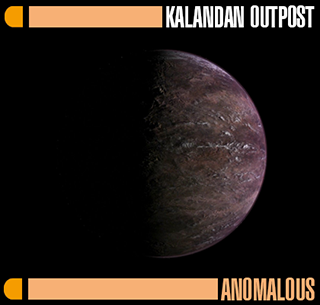
Often the strangest and most intriguing worlds are those that have been reshaped or even created whole cloth by a technologically advanced sentient species. There are literally no rules for what governs such planets. One may be millions of years old, another might only be several centuries old, and a starship could even encounter a world being constructed. The artificial planet created by the Kalandans and encountered by Captain Kirk's Enterprise in 2268 is an excellent example of such a created world. It is several thousand years old, roughly the size of Earth's moon, but with a gravity nearly that of Earth, a Class M atmosphere that supports limited plant life, and no surface water. As far as Federation geologists know, a world like that could never have naturally evolved. It can only exist because a sentient species designed and built it for a specific purpose. The Dyson Sphere discovered by the Enterprise-D in 2369 can be considered the most extreme known example of an artificial planet, and other possible options include ring and donut shaped worlds of various sizes.
There are also worlds that were once naturally created planets that have been drastically altered. Terraformed worlds like the Andorian world of Weytahn is an example of such a world. However, more technologically advanced species can perform far more extensive types of terraforming, including so-far theoretical possibilities like building a vast shell around a Class J or T planet and then terraforming the outer surface of this shell to create a Class M planet many tens or potentially even many hundreds of thousands of kilometers in diameter. Remember that if you ever encounter an artificial world or a world that has been radically altered by a more technologically advanced civilization, almost anything is possible.