Astronomical Objects
Even the newest recruit to Starfleet understands that space is a dangerous place. Even the smallest Main Sequence stars produce more energy per second than the entire Federation does with its antimatter reactors and fusion power plants. With that kind of energy, both beautiful and dangerous occurrences are commonplace across the Galaxy.
- Nebulae
- Flares, Radiation Storms and Geomagnetic Storms
- Ion Storms
- Novas
- Supernovas, Neutron Stars and Black Holes
- Pulsars and Active Black Holes
- Gravitational Distortions
- Exotic Events
Nebulae
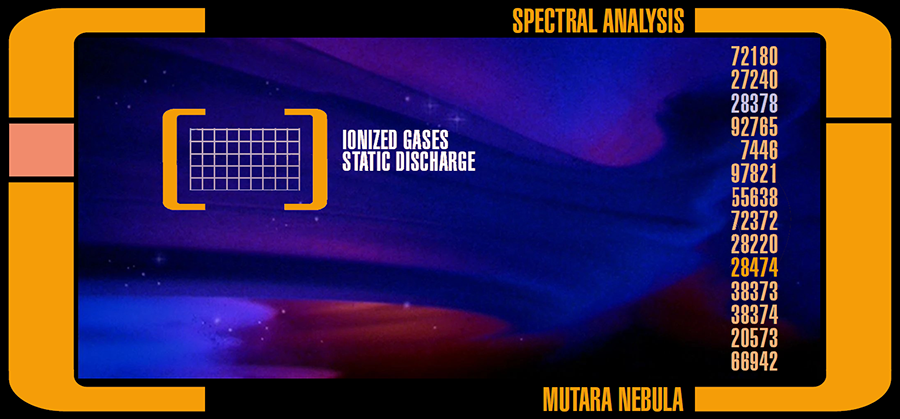
Nebulae are gas and dust clouds that are left over from stars that have undergone nova or supernova, or even gas clouds hundreds of light years across that still exist from before the formation of the Galaxy. Typically, these clouds are made up of hydrogen and helium, along with trace amounts of heavier elements. Nebulae are lit by ionization and light from stars (or stellar remnants) within them, and flying through such highly-charged clouds of gas tends to disrupt starship sensors. While warp travel through nebulae is possible due to a starships deflector array moving the particles away, slight gravitation eddies and density fluctuations mean cautious starship captains tend to go around nebulae rather than risk damaging their ships. Some nebulae have been in existence for billions of years without collapsing and can be home to strange native life-forms, so exploration of these beautiful clouds is often a priority. Examples of these objects are the Orion Complex, the Mutara Nebula, and the Coalsack Nebula.
Flares, Radiation Storms and Geomagnetic Storms
Flares, radiation storms, and geomagnetic storms are interlinked. Flares can occur on any star, but more often around small stars such as Class M Main Sequence stars. These bursts of energy erupt out of the star and often outshine the rest of the star for hours at a time. The charged particles and radiation from such flares can cause problems with a starship's shields and sensors, and unprotected crew on the surface of planets without a magnetic field can receive heavy doses of radiation. On worlds that do have a magnetic field, such as Earth, flares cause aurora that have the possibility to destroy large electronic networks, disrupt communications, and even stop transporter operations. Flare stars are stars that tend to have these events occur far more often than others. Examples of stars like this are: Proxima Centauri (home of Earth's earliest colony), Wolf 359 (site of the devastating battle against the Borg in 2367), and II Pegasi.
Ion Storms
Ion storms are severe versions of flares and radiation storms. They start the same way, with a powerful burst of energy from a star or stellar body, powerful enough that the radiation density of the pulse can ionize interstellar gases and punch through most planetary magnetic fields, causing severe damage to unshielded electronics and delicate ship systems. Ion storms can hold together over decades and travel across light-years before finally dissipating when conditions are right. Numerous examples in Starfleet history record encounters with ion storms, but none so strong as the Halkan Storm of 2267 that focused the subspace scanning array of Enterprise's transporter systems in such a way as to accidentally tunnel through subspace into a parallel timeline, beaming alternative versions of members of her bridge crew aboard.
Novas
A nova is the gradual death of a star as its core contracts and gets hotter, blowing off the outer layers of its atmosphere and that material accreting onto a nearby stellar partner (typically a white dwarf) which then accumulates mass until it explodes in an uncontrolled fusion reaction. As most stars form binary pairs this is an event that is semi-common, but still dangerous. The rapid expansion of stellar material away from the star's core can also result in the beginnings of a stellar nebula. These high-energy events wash out sensors, can sterilize worlds that are even protected by the most advanced shielding, and can pose significant radiation hazards to starship crews. These events can also spawn ion storms, radiation storms, and even geomagnetic events in nearby star systems.
Supernovas, Neutron Stars and Black Holes
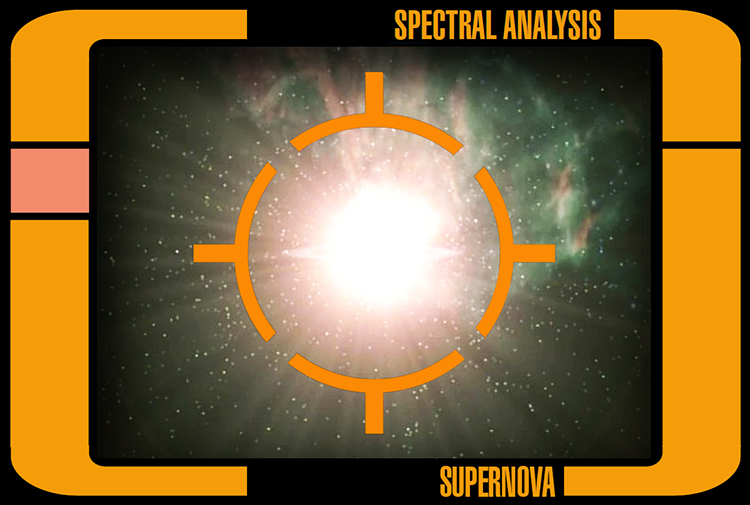
Supernovas, neutron stars, and black holes are intrinsically linked. As massive stars begin to run out of hydrogen in their core, there is enough mass and pressure to continue the fusion process using heavier elements such as helium, carbon, and even silicon. Once silicon begins to fuse into iron, the amount of energy produced from trying to fuse iron is not enough to hold back the immense pressures generated from the mass of these large stars, and gravitation collapse begins. Within seconds the star becomes billions of times brighter than it was as the explosive shock wave reaches a significant portion of the speed of light. The mass of the star's core determines if a neutron star or a black hole forms. Regardless, any starship near a star undergoing supernova is doomed to be vaporized even with the best shielding technology. Neutron stars and black holes alike can produce intense gravitational waves, extreme radiation hazards, and ion storm like effects across dozens of light-years, and even cause enough high energy radiation to sterilize worlds a handful of light years away.
Pulsars and Active Black Holes
Pulsars and active black holes are even more hazardous versions of neutron stars and black holes. Pulsars are rapidly rotating neutron stars with incredibly strong magnetic fields that channel charged particles and radiation into a beam emanating from two sides. Even from lightyears away starships in the path of these 'lighthouse' beams require heavy shielding and typically do not stay in the path for long. Active black holes are black holes that are currently devouring closely orbiting material, such as a star that came too close. The increasing velocities and densities close to the event horizon of the black hole heat the material to the point that it can emit x-rays and gamma rays. This radiation can cause severe damage to starships and star systems even lightyears away, causing intense ion storms, gravitational waves, and other stellar phenomena.

Gravitational Distortions
Gravitational distortion is a catch-all category for gravity waves and other events that cause ripples in space-time. These originate from high energy events such as supernovas, black holes, closely orbiting neutron stars, and collisions between massive objects. While most gravitational distortions occur fairly close (in astronomical terms) to these events, constructive interference of these ripples can sometimes cause 'rogue waves' much like on the oceans of Earth. Rotating massive objects also cause 'frame-drag' which can cause ships passing through such twisted space-time at warp speeds to undergo 'slingshot' time travel. Federation starship captains are ordered to never attempt such a thing, and those that do at best will have a career-ending interview with the Department of Temporal Investigations in whatever time they find themselves in.
Exotic Events
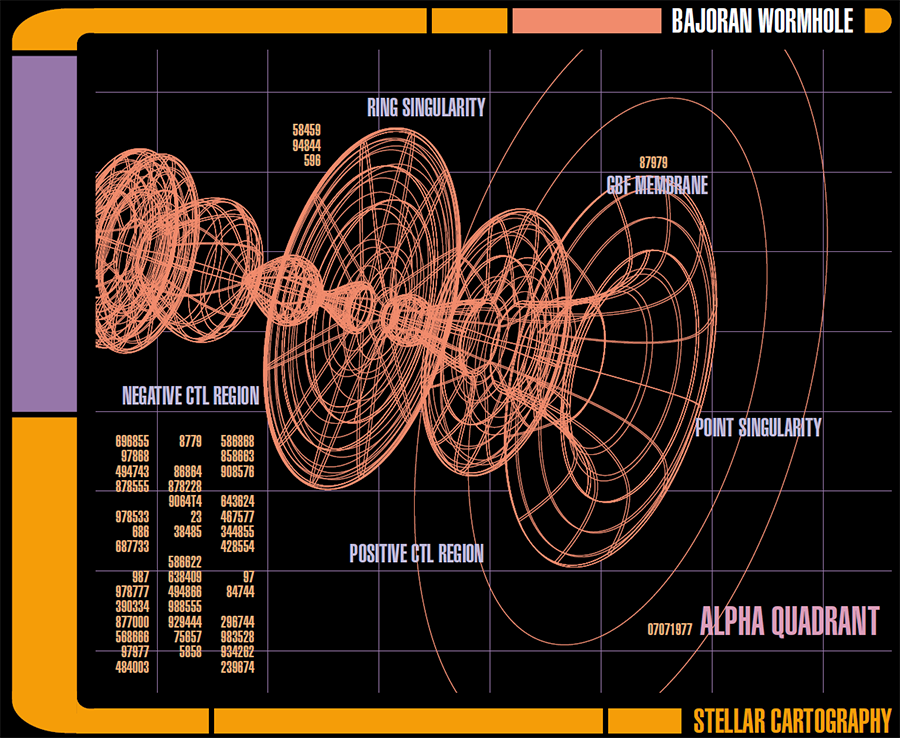
In the course of exploration, Starfleet has come across even more exotic events that have little hard scientific data collected about them as they are so rare as to not have been observed enough for proper theories to explain their formation, or close observation and analysis is impossible. Wormholes are points in space-time that link across light-years and allow movement of information or even matter through them. Wormholes are always unstable with their ends moving through space and time, except for the notable example of the Bajoran wormhole. Subspace Rifts are extreme distortions in space-time, like gravitational distortions and wormholes, but reach into the underlying realm of subspace. These rips can impede warp field stability and even allow for travel between nearby parallel time streams. Colliding Neutron Stars have never been observed by Starfleet as this event is thankfully rare. The amount of energy released in a possible neutron star collision would be enough to sterilize all life within a few thousand lightyears of the event and cause extinction events in thousands more. Micro Black Holes are nearly impossible to detect at long range and can cause severe damage to starships as they pass straight through shielding and matter, devouring everything in its path. A Vacuum State Change is only theorized, but any observations of the underlying fabric of space and time changing instantly into another form would likely be the last observation a member of Starfleet ever made. A Vacuum State Change could literally change the laws of physics to the point where atoms themselves fly apart as the strong nuclear force weakens to near zero, or the speed of light slows to a crawl and time dilation effects could occur at walking speeds.