STELLAR CARTOGRAPHY - TRILL
TRILL SYSTEM
SYSTEM INFORMATION
- System Name: Trill B (Federation Astronomic Catalog)
- Traditional Name: Trillius Prime, Trill
- Location: Alpha Quadrant, Kalandra Sector
- Type: G2V (Yellow Main Sequence); binary of Trill A (K5V)
PLANETS
| Position | Name | Class | Diameter | Density (Composition) | Gravity |
|---|---|---|---|---|---|
| I | Deran | B | 10,400 km | 5.6 (Medium Iron) | 0.83g |
| II | Iopa | B | 11,067 km | 2.7 (Silicate) | 0.43g |
| III | Canar | N | 9,854 km | 6.2 (High Iron) | 0.87g |
| IV | Trill | M | 12,986 km | 5.3 (Medium Iron) | 0.98g |
| V | Leko | K | 8,822 km | 6.0 (Medium Iron) | 0.76g |
| VI | Nion | J | 61,200 km | 1.3 (Gas Giant) | 1.3g |

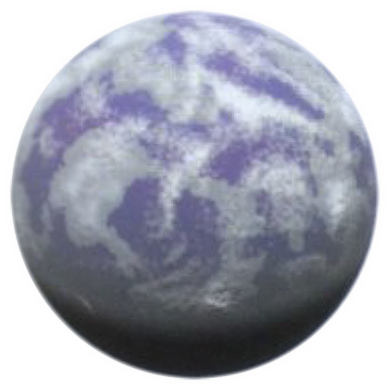
TRILL
Traditional Name: Trill
- Position in System: IV
- Number of Satellites: 1
- Mean Density: 5.30 g/cm3
- Mass: 5.872 x 1024 kg
- Planetary Gravity: 0.98G
- Planetary Size
- Diameter: 12,986 km
- Equatorial Circumference: 40,797 km
- Total Surface Area: 529,786,234 km2
- Percent Land Mass: 30%
- Total Land Area: 158,935,870 km2
- Volume: 1.14663 x 10¹² km3
- Planetary Conditions
- Length of Day: 26.6 hours
- Length of Year: 1.32 Earth Years
- Atmospheric Density: Standard
- Mean Atmospheric Pressure (sea level): 101.2 KPa (0.999 atm)
- Axial Tilt: 23°
- Seasonal Variation: Moderate
- General Climate: Warm Temperate
- Mean Temperature at 30° Latitude
- Low: 13° C
- Average: 24° C
- High: 35° C
Planetary Profile
Trill is the fourth planet of six orbiting a yellow star. Trill's sun has a binary partner, an F-class yellow-white star. Thanks to a strong axial tilt and pair of primary stars, Trill experiences frequent weather changes and warm, tropical weather. The Trill maintain a simple weather control system in place to influence disastrous storm fronts or disperse sudden dangerous weather, but generally prefer to leave the weather to its natural course. Natural features on Trill included forests, lakes, canyons, and caves. A combination of algae and unusual salts gives Trill's oceans a pleasant purple color.
Due to its tectonic instability, Trill experiences occasional quakes and plate shifts, although volcanic activity is rare (the planet has a relatively cool core). As a result, the planet tends to have stark mountains and hilly terrain, but these all erode quickly under the onslaught of the changeable weather. The Trill themselves use a system of tectonic sensors and release stelae to help keep the quakes manageable in populated areas.
Most of the planet sprouts tremendous, green forests; under the canopies, the warm weather and winds are a bit more tolerable. At the poles, though, the planet still boasts permafrost icecaps. Thanks to the quakes, cave complexes are common among the mountains.
Trill Physiology
Trill are humanoids of average height with a series of pigmented spots on their skin, which wreath their face and continue down their body all the way to their toes. Each of these patterns was unique, being as distinctive as the fingerprints of a Human. Trill were marsupials, and as such, had abdominal pouches with which to provide incubation for their newborns. Both males and females had pouches, and both sexes were capable of incubation. The pouch was also used as a conduit for medications to quickly enter the body, as well as the joining point between host and Trill symbiont.
A small percentage of the Trill population harbored a sentient lifeform known as a symbiont inside their bodies, a symbiotic relationship that played a significant role in Trill culture and society. Such "joined" Trill had personalities that were a synthesis of the two beings, and could access the memories and skills of previous hosts.
The few Trill that were given a symbiont were typically joined in their early- to mid-twenties. The physical process of being joined was irreversible. Once joined, the host and symbiont were dependent on each other after a ninety-three-hour period in which the symbiont bound itself to its host's nervous system. If the symbiont was removed from the host, symbiont and host would die within hours, even if they were otherwise healthy, unless they were implanted into another host or with another symbiont. Joined Trills were also extremely allergic to insect bites; the biochemical connections between the host and symbiont could not tolerate the reaction caused by the insects' venom.
Symbionts
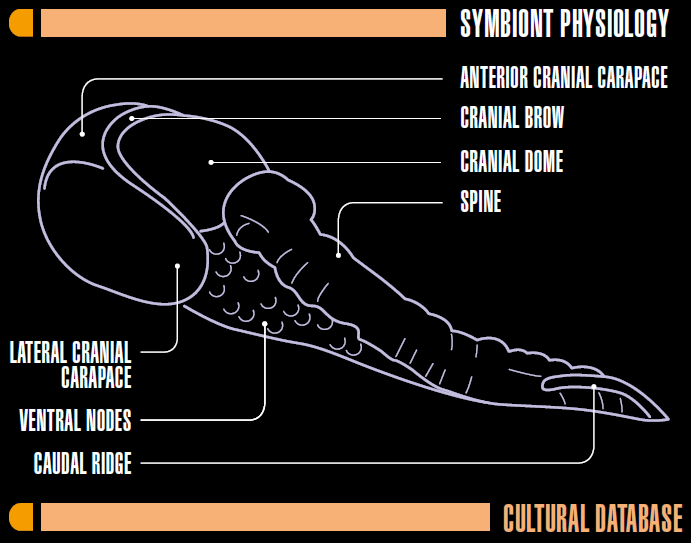
Symbionts are small, sightless vermiform roughly 30 centimeters in length. One symbiont is able to hold the memories of countless lives it lived before it enters a new host, and this denotes an extremely complex nervous system. They are joined with Trills via an incision made in the Trill's abdominal pouch. Once an incision is made, the symbiont is inserted and it latches on to the Trill's circulatory and nervous systems. It takes 93 hours for the host and symbiont to be fully joined, and during this time they are both carefully monitored to ensure the process goes smoothly.
Symbionts themselves live for several hundred years or more – their full life cycle remains largely a mystery outside the Commission and the Guardians who protect unjoined symbionts – as long as they are able to travel from host to host. Outside of a host, they die and all the knowledge contained within them is lost. Like any other creature, they are susceptible to diseases which are unique to their physiology. The disease may only affect the symbiont, but are still deadly to a Trill if left uncured, because of the symbiosis both share.
Government
In the 21st century, Trill was governed by a ruling council, composed solely of joined Trills, and primarily males. The council was led by a head counselor, addressed as The Speaker. By the 24th century, the Trill government was known as the Trill Assembly.
The Trill Assembly is divided into junior and senior members. Senior members, whose symbionts had lived more than one lifetime, were allowed to call general meetings. Junior members, whose symbionts had lived only one, were not. Membership was restricted to joined men until the 21st century.

History
The Trill humanoid form evolved from fur covered marsupials. The earliest joinings between Trill and symbiont date to prehistory, with written records only going as far back as the last millennium or so. The symbionts' ancestral home was in the underground caves, including the Caves of Mak'ala. The root cause of the initial joinings is unknown, but archaeological evidence points to an environmental disaster leading the two species to begin integrating with each other.
As Trill society grew, their governments adopted a system influenced by the symbionts. The symbiont populations grew much more slowly than the Trill humanoid populations, so many Trill competed to have the right qualifications to be selected as a host. This general competitiveness showed through academic achievement and philosophical development—the symbionts made it clear that they would reject violent individuals who tried to become hosts by force. As a result, all Trill civilization stressed a high level of education and ethical personal responsibility. By the time they'd covered all of their planet's landmasses, the Trill already had a unified world government, a meritocracy run through systems of examinations and scientific appointments.
Trill's first contact with alien life was in the early 21st century, when a Vulcan ship landed, proposing friendship and cultural information exchange. Trill society was deeply divided by this development, with many fearing the outsiders represented a threat to the symbionts. The ruling council eventually allowed for limited contact with Vulcans, but no other alien races. This first contact also led to increased security around and secrecy regarding the symbionts.
By the 22nd century, Trill had largely tamed their world, and engaged in rudimentary space travel and contacts with other cultures through subspace radio. The close of the 22nd century saw the Trill invention of warp drive, and by the 23rd century Trill warp engines were on par with most Starfleet designs; Trill travelers became a common sight throughout the Alpha Quadrant, although their symbionts remained secret and the Trill had little desire to colonize or conquer other worlds. Some adventurous Trills had enlisted in Starfleet by the middle of the 23rd Century, but the planet Trill did not become a full Federation member until 2285.
Despite the relatively unusual nature of being a joined species, that aspect of their culture was not widely known until 2367, when the Odan symbiont had to be given a new host during the middle of tense negotiations on Peliar Zel. Such a public example of the dual nature of the Trill brought to the forefront what had previously for several millennia been a very private matter for the Trill.
Culture
Trill society is relaxed, open, and generally playful. Having experienced multiple lives, most Trill know how to have a good time and how to avoid things that bring unhappiness. Discussions are important to have, but arguments are a waste of time. Why fight someone when you can try to understand them instead?
The Trill's appreciation for understanding extends to other cultures who pique their interest. They are ever curious about other races, and love to learn about their culture and practices. Once a Trill learns another culture's practices they take them to heart and ensure they are respected. It would not be odd to see a Trill who has mastered Klingon culture to punch a Klingon in the face for doing something rude. This isn't because the Trill has totally taken on a Klingon persona, but because they respect Klingon culture and want to exhibit the correct response. This flexible and relaxed nature to other species has made Trills invaluable as Federation diplomats and peacemakers.
The symbiont forms the center of TriII society. They have touched every aspect of Trill culture, and society revolves around them. Rules governing marriage, the education system, the legal system-all have been designed to account for the needs of the symbionts. In fact, it is impossible to discuss Trill society independently of the symbionts.
Trill are a species of over-achievers, as they all crave symbiosis with a centuries-old intellect. Federation psychologists believe that Trill somehow feel incomplete without a symbiont, that joining may be a biological impulse that gradually wears off with age. As the product of millennia of symbiosis, Trill society is highly advanced and highly sophisticated. They possess a rich trove of literature, music, and art. The Trill are also a technologically advanced species and the Trill Science Ministry was a leading center of scientific research and experimentation.
While Trill society was sharply gendered for generations, the custom of symbionts swapping between successive male and female hosts made for an androgynous subculture.
Joining
On average, only three hundred symbionts were available for hosting each year and about a thousand Trills apply for joining. Because there were many more humanoid Trills than symbionts, prospective hosts were weeded out by a demanding selection procedure, overseen by the Symbiosis Commission.
The competition for the few symbionts was fierce and attracted the brightest and most highly motivated of Trill society. Often, the would-be hosts excelled in their chosen fields and it was not uncommon for them to hold several degrees or distinctions prior to their joining. Prospective hosts may eventually become initiates under the supervision of a field docent, a joined Trill who evaluates the prospective host's suitability for joining and makes a recommendation to the Commission. A negative recommendation usually meant the initiate was cut from the joining program.
Common belief in Trill society holds that only one in a thousand Trills make acceptable hosts. In fact, this figure was vastly understated, and nearly half of the Trill population was capable of being joined. The myth was perpetuated very carefully, though, in order to avoid widespread chaos which would probably arise if the information were made public, since the symbionts would become, essentially, objects to be fought over, as people fought to gain the few prized symbionts.