STELLAR CARTOGRAPHY - DELTA IV
DELTA SYSTEM
SYSTEM INFORMATION
- System Name: Delta Principus (Federation Astronomic Catalog), V2292 Ophiuchi (IAU Catalog), 114 Delta (UESPA Catalog)
- Traditional Name: Delta, Lta
- Location: Alpha Quadrant, Sector 12102
- Type: F4V (Yellow-White Main Sequence)
PLANETS
| Position | Name | Class | Diameter | Density (Composition) | Gravity |
|---|---|---|---|---|---|
| I | Amia | B | 6,900 km | 7.6 (Metallic) | 0.75g |
| II | Xeria | H | 8,800 km | 5.0 (Medium Iron) | 0.63g |
| III | Seyalia | M | 12,000 km | 5.9 (Medium Iron) | 1.01g |
| IV | Dhei (Delta) | M | 15,000 km | 4.5 (Low Iron) | 0.95g |
| V | Tholla | C | 8,700 km | 3.7 (Low Iron) | 0.46g |
| VI | Cohiri | J | 61,500 km | 1.4 (Gas Giant) | 1.22g |
| VII | Zocruhiri | J | 118,000 km | 1.7 (Gas Giant) | 2.84g |
| VIII | Athea | J | 51,300 km | 2.0 (Gas Giant) | 1.45g |

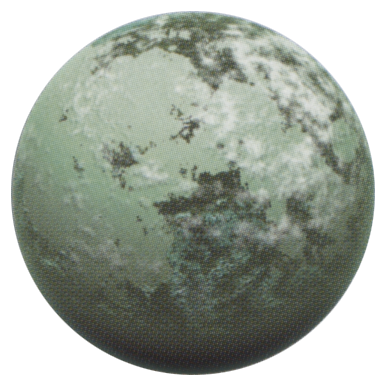
DELTA IV
Traditional Name: Dhei (Delta)
- Position in System: IV
- Number of Satellites: 2 (Seyann, Cinera)
- Mean Density: 4.47 g/cm3
- Mass: 7.89914 x 1024 kg
- Planetary Gravity: 0.95G
- Planetary Size
- Diameter: 15,000 km
- Equatorial Circumference: 47,000 km
- Total Surface Area: 706,900,000 km2
- Percent Land Mass: 60%
- Total Land Area: 424,000,000 km2
- Volume: 1.76715 x 10¹² km3
- Planetary Conditions
- Length of Day: 20 hours
- Length of Year: 2.37 Earth Years
- Atmospheric Density: Thin
- Mean Atmospheric Pressure (sea level): 80.05 KPa (0.79 atm)
- Axial Tilt: 15°
- Seasonal Variation: Minor
- General Climate: Cool Temperate
- Mean Temperature at 30° Latitude
- Low: 4.4° C
- Average: 15.6° C
- High: 26.7° C
Planetary Profile
Delta IV, also called Delta or Dhei, is the fourth planet of the Delta Principus system. The planet has two moons, Seyann and Cinera, both of which support large underground cities with Federation port facilities. These cities are home to a large population of off-world humanoids to help limit exposure to Deltan pheromones while conducting business in the Delta system.
Delta is a beautiful, green Class-M world with vast forests covering much of the planet's surface. The planetary land mass consists of three main continents and countless island chains scattered across Delta's large oceans. The continents share a common arrangement, with fertile plains and forests along the coasts gradually transitioning to mountainous interiors. The islands dotting the oceans follow a similar layout in miniature. The planet's two moons create complex, somewhat unstable tides.
Environmental conservation of the abundant flora has long been of primary concern to the native population. It is interesting to note that Delta has the lowest animal species extinction rate in the Federation, a result of the Deltan's artistic blending of technology and nature. Delta's soil is so unusually fertile that plants from all over the Federation have adapted quickly to the Deltan climate.
Even before joining the Federation, Delta IV gained renown as a cosmopolitan world. Gleaming cities filled with towering spires and full domed structures dot its coastlines. Since social interaction makes up a primary part of Deltan lives, meeting places pack their cities. As the Deltans prefer to live in close proximity to each other, large swathes of the planet remained undeveloped, offering a number of natural attractions. Lush forests, jagged mountains and deep valleys give many parts of Delta IV a wild, untamed look that belies the Deltan's advanced civilization.
Deltan Physiology
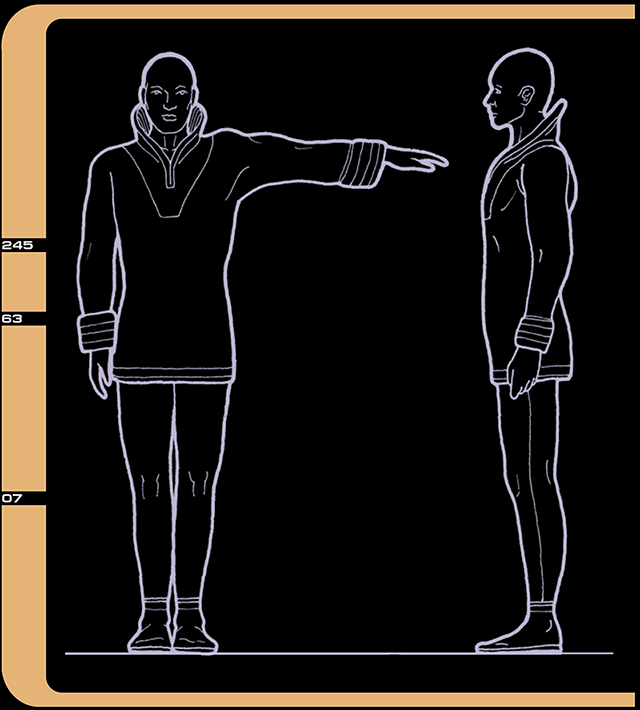
The dominant species of Delta IV are the Deltans, a humanoid species physically varying only slightly from the Terran norm. Averaging 1.7 meters high with a medium to slim build, these humanoids' most noticeable physical feature is their natural baldness. Deltans have no surface hair except for eyebrows, lashes, and (occasionally) a very thin layer of soft down along arms and legs. Other than this, they closely resemble Humans or Betazoids. Deltans are, on the average, slightly slimmer than Humans, and their cheekbones, eye shapes, and jawlines are slightly more symmetrical. Humans (and many other humanoid species) often find Deltans quite attractive.
All Deltans possess an unusual biochemical makeup that generates pheromones which sexually stimulate not only other Deltans but also cause many other species to find the Deltans very sexually appealing. Deltans are also naturally empathic; like Vulcans, Deltans are talented telepaths and can easily sense the emotions of others. The combination of pheromones and empathic ability makes the Deltan seem extremely attractive and desirable to each other as well as many other humanoid species.
For this reason, after joining the Federation any Deltans were required to swear an oath of celibacy before serving at any facility that employed other humanoid races. Chemical applications developed by the Deltans are capable of diminishing the pheromonal effect, and such treatments had been made mandatory within confined spaces, such as aboard a starship. By the 24th century, Deltan protocols with other species in the Federation were well established and the oath of celibacy has been relaxed somewhat due to growing cultural exchange and understanding.
Government
Delta IV is governed by the Deltan Union, which joined the United Federation of Planets in 2223. The Union consists of an Executive Branch, the Chamber of Ministers, headed by a Prime Minister, and a Legislative Branch consisting of a bicameral parliament made up of the Representative Council and the Paramount Council. The Representative Council is made up of the elected representatives of the populace while the Paramount Council is made up of senior members of the Deltan nobility, also called the Paramounts. The Paramounts are the heads or senior representatives of the families descended from the royal, clan and tribal leaders of the various nation-states that banded together to form the original unified council that evolved into the Deltan Union. The head of the Paramount Council, the First Among Equals or Archparamount, is elected by the Paramounts and serves as the de jure head of state for the Deltan Union, though the reality is that the Prime Minister is de facto head of state.

History
The Deltan people evolved on the continent of Anatoria on Delta IV. Mountainous interior to one side and unpredictable tides on the other kept the early Deltans concentrated on the coasts. Deltans avoided war and other large scale conflicts thanks to their pheromones and empathic abilities. Deltans' strong pheromones made them physically unable to hide their emotions; and their empathy meant that any pain inflicted would also be felt by the one inflicting it.
During the early centuries of Deltan civilization, the people thrived on the plentiful food and the cool, temperate climate of the planet. Eventually, overcrowding began to mar the otherwise comfortable Deltan lifestyle. Eventually, a new and deadly virus developed and spread like wildfire throughout the population. Before they could learn how to combat it, the plague had claimed about 90 percent of the Deltan population. One positive effect of the plague was to instill a sense of discovery into the Deltan people as those attempting to flee took to the water, eventually mastering the navigation of the unpredictable tides and opening up the rest of their world to them.
The Deltan people spread across Delta IV over the next several centuries, with the proliferation of island chains and mastery of the seas meaning that lines of communication remained open, leading to a culture at once polyglot and unified although many microcultures evolved on the planet's myriad islands and far shores, they could never remain isolated long enough to develop either xenophobia or devastating cultural advantages.
Aside from the obvious impact on the population, the plague had a major effect upon Deltan society and philosophy. Deltans put a great deal of effort into scientific study and advancement, believing that the disaster would have been averted had their scientific knowledge been more advanced. The event marked a rapid rise in Deltan technology. After achieving spaceflight, the Deltans soon discovered that their sister world, Delta III (Seyalia), was also habitable. Permanent colonies took some time to establish, as the Deltan need for near-constant companionship required larger starship crews. Delta III proved to be an abundant source of industrial metals as well as having a small cache of dilithium crystals.
Warp capability soon followed the acquisition of dilithium crystals, turning the Deltans into an insterstellar species. First Contact with the Andorians occurred shortly after the Deltans took to the stars, and the Deltans started colonies on worlds like Raritan IV. Contact with human traders occurred in the mid-22nd Century, and a misinterpretation of the Deltan name for their homeworld (Dhei-Lta, literally the planet Dhei in the Lta star system) led to its name on the United Earth navigation charts being noted as Delta, a name which has persisted. These early encounters with Humans also revealed the potent effect of Deltan pheromones and empathic abilities on some other humanoid species and led the Deltans to initially keep themselves emotionally separated when dealing with alien species, making them seem cold and aloof.
This policy delayed Delta IV joining the Federation for several decades, until policies were established to help protect other species from the effects of being in proximity to the Deltan pheromones. The most notable of these policies was requiring an Oath of Celibacy by any Deltans serving in close proximity to other humanoids, a policy that was rigidly adhered to for over a century before changing attitudes in the Federation led to a gradual easing of the requirement. Deltans can be found in numerous positions across the Federation and in particular Starfleet. Deltans serve as navigators, scientists, doctors, and are exceptionally good as ship's counselors, a position created in part by the persuasive efforts of Deltans and Betazoids.
Spared any direct damage from the Dominion War, today Delta IV is enjoying an increase in its influence in the Federation. As part of the Federation efforts to rebuild after the War, the Deltans have led many of the recovery efforts, taking the opportunity to spread their cultural philosophies encouraging cooperation and acceptance. They have also strengthened their presence in the Diplomatic Corps as the Federation efforts to expand, initially spurred by the need for more allies against the Dominion, have continued.
Culture
Deltans are basically sensualists, being primarily motivated by intense physical experiences. According to their religion, existence is a chain of experience, and life is simply a single link in that chain. No one knows what is at the end of that chain or even what the next link of the chain will bring. Life is experienced only once, and the individual must gather as much experience as possible before proceeding to the next step of existence. Once the individual has passed beyond life, the chance to experience many things will be lost forever. Deltans are renowned as the Federation's most sexually advanced race, and outsiders regard tales of incredible physical rapture and emotional pain with trepidation. For Deltans, the connection between people during their most intimate moments holds a significance that nothing else can equal.
Despite their highly developed senses of identity and humor, Deltas respect other cultures and their belief is similar to the Vulcan IDIC concept, Deltans regard all other societies as being part of the beautiful creative processes that form the basis of their religion. The most important facets of life on Delta V are art and mathematics (with almost everything enjoyed and interpreted in a sexual manner). Aside from sex, the main driving force of the Deltans is their love of beauty. In their religion, the Deltan body is considered the most important artifact.
Since social interaction makes up a primary part of Deltan lives, meeting places pack their cities. Music clubs, discussion halls, restaurants, shopping centers and other buildings draw Deltans as much for the chance to meet others as for their other enticements. The arts also seem to emphasize the people's social nature, with plays, performances and music proving more popular than the visual arts or cinema.
Deltan culture tends to be highly cooperative, and throughout their history Deltans maintained strong social groups and ties. Cooperation plays as large a role in almost all areas of Deltan life. Delta IV's industry and agriculture tend toward large projects handled by scores of people. Universities are also well-established, with hundreds of students taking classes together and joining in feverish discussions.
Children, surprisingly, play little role in most Deltans' day-to-day life. Until they begin generating the pheromones that mark them as achieving adulthood, mature Deltans pay them little heed. Children are still sensitive to the pheromones of adult Deltans, but initially only those they are closely related to. To compensate for the child's lack of pheromones, immediate family members will usually rely on increased empathic connection.