STELLAR CARTOGRAPHY - CESTUS III
CESTUS SYSTEM
SYSTEM INFORMATION
- System Name: Cestus
- Location: Beta Quadrant, Sector R18
- Type: A0V (Blue-White Main Sequence)
PLANETS
| Pos. | Name | Class | Diameter | Density (Composition) | Gravity |
|---|---|---|---|---|---|
| I | Cestus I | D | 15,987 km | 2.5 (Silicate) | 0.57g |
| II | Cestus II | H | 11,032 km | 4.2 (Low Iron) | 0.66g |
| III | Cestus III | M | 14,300 km | 5.4 (Medium Iron) | 1.1g |
| IV | Cestus IV | K | 10,215 km | 7.0 (High Iron) | 1.0g |
| V | Cestus V | D | 15,192 km | 3.4 (Low Iron) | 0.74g |
| VI | Cestus VI | J | 58,521 km | 1.3 (Gas Giant) | 1.1g |
| – | Asteroid Belt | – | – | – | – |
| VII | Cestus VII | K | 4,856 km | 5.7 (Medium Iron) | 0.39g |

CESTUS III
Traditional Name: Cestus
- Position in System: III
- Number of Satellites: 1
- Mean Density: 5.40 g/cm3
- Mass: 8.268 x 1024 kg
- Planetary Gravity: 1.01G
- Planetary Size
- Diameter: 14,300 km
- Equatorial Circumference: 44,500 km
- Total Surface Area: 642,424,282 km2
- Percent Land Mass: 44%
- Total Land Area: 282,666,684 km2
- Volume: 1.531 x 10¹² km3
- Planetary Conditions
- Length of Day: 21 hours (0.88 days)
- Length of Year: 3.3 Earth Years (1,207 days)
- Atmospheric Density: Standard
- Mean Atmospheric Pressure (sea level): 104.36 KPa (1.03 atm)
- Axial Tilt: 9.2°
- Seasonal Variation: Minor
- General Climate: Warm Temperate
- Mean Temperature at 30° Latitude
- Low: 15.1° C
- Average: 26.3° C
- High: 38.4° C
Planetary Profile
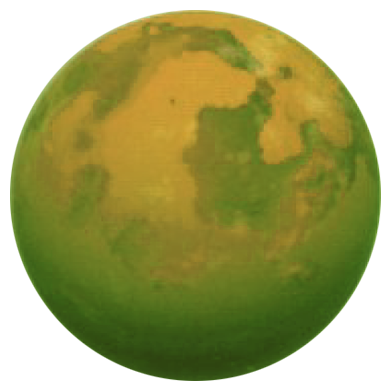
Cestus III has one main land mass, a large, bowl-shaped continent that fills most of its southern hemisphere. A long chain of mountains runs along the middle of it, and the planet's six main population centers dot the coast. Several smaller continental landmasses lie in the northern hemisphere. Because of its relatively small hydrosphere, the climate on Cestus III tends to be dry, if comfortably mild. Even along the equator, temperatures rarely exceed 30 degrees C. Storm systems are relatively mild and they are more welcomed for the precipitation that they bring than feared for their destructive power.
Civilization
Cestus III hosts a comfortably prosperous Federation colony populated mostly by Humans, but with a healthy scattering of other races as well. Its economy produces enough goods and services to meet its basic needs, except in the way of high-tech manufactured products and consumer goods. It exports some industrial minerals, as well as agricultural products (primarily exotic hybrid fruits and wines and liqueurs distilled from them).
A colonial governor administers the planet in the name of the Federation. Despite its success, Cestus III has been regarded as a backwater. Governors have tended to be either civil servants looking for a quiet post at the end of their careers, or also-rans who were passed over for more desirable jobs. A few have been frustrated cold warriors who see the Gorn as a potential threat rather than quiet neighbors.
Despite early tensions, the Gorn also now maintain a presence on Cestus III. Some hawkish citizens claim that it's so they can keep a close eye on the Federation presence near Gorn space. The more open-minded citizens, however, have integrated the Gorn into their efforts; trade and exchange between Gorn and Humans is common here.
History
For half a century before Federation explorers on the USS Coronado discovered Cestus III in 2258, the reptilian spacefaring race known as the Gorn claimed it as their own. On its merits, the planet held little interest for them; although its warm, dry climate suited them, there was no intelligent life there and they couldn't find much in the way of exploitable resources. Besides, the Cestus system was situated on the fringe of their stellar empire, making it hard to defend. They established no permanent presence there and patrolled the area infrequently.
So it was that the Federation might be forgiven for assuming that Cestus III was unclaimed when it followed up its discovery in 2262 by establishing a small outpost there, staffed by pioneers, research scientists and a few Starfleet security guards. The Gorn saw this as an invasion by unknown aliens. In 2267 they dispatched a warship to the planet, which promptly wiped out the nascent colony.
When the USS Enterprise came to investigate the attack, a mysterious advanced race called the Metrons intervened and forced Captain James Kirk and the Gorn captain to fight to the death to settle the dispute. When Captain Kirk refused to administer the coup de grace to his fallen foe, this gesture opened the way for peaceful relations between the two sides. Following intervention by the Metrons, the Gorn ceded Cestus III to the Federation. The planet became a thriving colony world over the course of the next century, with several cities springing up across the planet, including Pike City (the capital), Johnson City, Lakeside, New Chicago, Palombo, Port Shangri-La, and Prairieview, and eventually was elevated above its colony status to become a member in its own right.
Soon after, UFP settlers streamed in to exploit its mineral wealth (what there was, anyway), conduct agricultural experiments on alien soil and pursue trading opportunities with the Gorn. Over the next century, colonists achieved the most success crossbreeding fruits transplanted from Earth with native plants to produce wines, liqueurs and agricultural products unique to the planet. Trading relationships with the wary Gorn proved more elusive, however, as did opportunities to make money off of the planet's natural resources. The colony's economy grew steadily, but slowly.
Following the normalization of relations with the Gorn Hegemony in the aftermath of the Dominion War a small Gorn presence was established on Cestus III on one of the larger islands in the northern hemisphere, centered on a city called Hrisstan. Recent discoveries have pointed to a far older Gorn history on the planet than previously known, and a joint archaeological effort has been underway for the last year that has uncovered several ancient Gorn artifacts.