STELLAR CARTOGRAPHY - CAIT
CAIT SYSTEM
SYSTEM INFORMATION
- System Name: Cait (Federation Astronomic Catalog), 15 Lyncis (IAU Catalog)
- Traditional Name: Caitia
- Location: Alpha Quadrant, Sector 419228
- Type: F8V (Yellow-White Main Sequence)
PLANETS
| Position | Name | Class | Diameter | Density (Composition) | Gravity |
|---|---|---|---|---|---|
| I | Navelea | N | 6,338 km | 3.3 (Low Iron) | 0.3g |
| II | Ferasa (Cait) | M | 10,100 km | 6.8 (High Iron) | 0.98g |
| III | Rupra | D | 8,727 km | 4.9 (Medium Iron) | 0.61g |
| IV | Athea | H | 4,112 km | 4.0 (Low Iron) | 0.23g |
| V | Nuna | D | 16,086 km | 5.8 (Medium Iron) | 1.33g |
| – | Asteroid Belt | – | – | – | – |
| VI | Kenanri | D | 14,171 km | 6.6 (High Iron) | 1.33g |
| VII | Tiria | H | 13,417 km | 4.9 (Low Iron) | 0.94g |
| VIII | Karuta | D | 9,092 km | 6.8 (High Iron) | 0.88g |
| IX | Lurega | I | 27,135 km | 2.1 (Gas Dwarf) | 0.81g |
| X | Dephara | P | 20,406 km | 6.1 (High Iron) | 1.77g |
| XI | Kasha | C | 15,688 km | 5.7 (Medium Iron) | 1.27g |
| XII | Gara | D | 4,836 km | 6.3 (High Iron) | 0.43g |


CAIT
Traditional Name: Ferasa (Cait)
- Position in System: II
- Number of Satellites: 2 (Rea, Sura)
- Mean Density: 6.81 g/cm3
- Mass: 3.67327 x 1024 kg
- Planetary Gravity: 0.98G
- Planetary Size
- Diameter: 10,100 km
- Equatorial Circumference: 31,730 km
- Total Surface Area: 320,474,000 km2
- Percent Land Mass: 50%
- Total Land Area: 160,237,000 km2
- Volume: 5.39464 x 10¹¹ km3
- Planetary Conditions
- Length of Day: 27 hours
- Length of Year: 2.59 Earth Years
- Atmospheric Density: Thick
- Mean Atmospheric Pressure (sea level): 132.7 KPa (1.31 atm)
- Axial Tilt: 25°
- Seasonal Variation: Moderate
- General Climate: Warm Tropical
- Mean Temperature at 30° Latitude
- Low: 18.3° C
- Average: 29.4° C
- High: 40.6° C
Planetary Profile
Ferasa (Cait) is a warm, tropical world of thick, lush jungle, sunny, grassy plains, and wide, sandy beaches. Its thick atmosphere is perfumed with the scent of the dense jungle. Though hot and sunny, frequent breezes sweep its shores and plains. The planet's climate is inviting to most life forms, and Cait has become a popular tourist stop (except during its short rainy season). The abundance and variety of plant and animal life have kept Caitian zoologists and botanists busy for centuries, and off-planet scientists find Caitian ecology a complex and fascinating topic.
Cait's abundance extends well below the surface, with a metal rich interior. Despite this bounty beneath their feet, Caitians rely far more on the asteroid belt that lies between the fifth and sixth planets of the Caitian system for resources. The asteroid belt is a major source of ores and valuable minerals, not the least of which is dilithiurn. Orbital refining platforms within the belt provide a large percentage of the dilithium crystals used in that area of Federation space.
Caitian Physiology
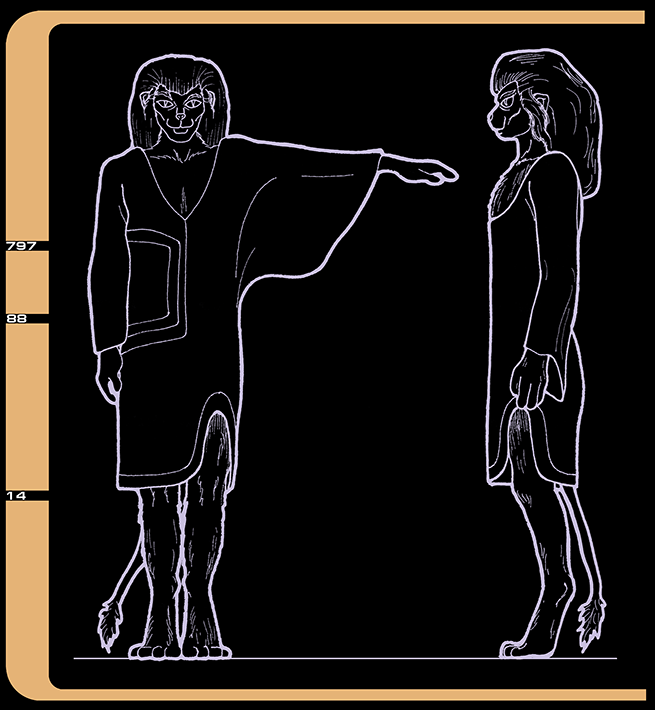
Caitians are upright, bipedal beings with manipulative hands that closely resemble a variety of Terran felines, with flat noses, fore-mounted eyes, tufted ears, whiskers, prominent canine teeth, long tails and are covered in fur that could be orange, brown, gray, or black, and could also be solid, multicolored, or patterned. Some Caitians have four fingers (including a thumb) on each hand, while others have five. Additionally, the feet of some Caitians possess a digitigrade configuration, while others have a plantigrade foot structure. Caitians have excellent hearing, with a frequency range far beyond that heard by normal humanoids and their eyes provide excellent low-light vision.
When they need to move quickly, Caitians can switch to quadrupedal locomotion, displaying feline agility and reaction times. They have sharp claws on their hands and feet, which leads some to prefer going without footwear. Their claws could be used combatively, or to scale vertical surfaces, such as cliffs. Caitians are one of the few species actively serving within Starfleet that possess a tail – which requires alterations to standard Starfleet uniforms.
Caitians were mainly carnivorous, but have adapted to a more omnivorous diet consisting of vegetables and a form of synthetic meat perfected over centuries.
Government
The Caitian planetary government is a coalition of clans called the Ferasan League. One clan, the Vr'aun, are considered the rulers. The eldest member of the Vr'aun rules as Agra'nn (translated as either "King" or "Chairman") for three years, then passes the rule to the next eldest. In this system, the rulers have lived as regular working members of the society before taking office, and are respected for their experience and knowledge. The Caitians adore pomp and ritual, and enjoy having a coronation every three years. Retired Agra'nn are still highly respected members of the society, and reside in the L'lura, a combination palace-and-library, where Caitians may consult them on any social or philosophical questions.

History
Caitians are distantly related to the Kzinti, which initially led some to theorize that Ferasa (Cait) began as a Kzinti colony. As archaeological evidence shows that Catian presence on Ferasa predates known Kzinti development of interstellar travel by millennia, modern theories postulate that the Caitians were transplanted to Ferasa by a more advanced species, with the leading candidates being the Preservers, possibly to save primitive Kzinti cultures facing extinction with the rise of the dominant Kzinti Patriarchy culture.
The abundance of their new world all but eliminated the need for competition among the early Caitian clans. Early Caitians spent their whole lives on the move, prowling across hundreds of square kilometers of forest and plain. Caitian society evolved as a loose confederation of matrilineal clans, meeting at specific locations for mining, government, and other relatively fixed functions. As these predators moved out of the jungle, they turned to the waters for food. Caitian civilization moved towards a fishing, seafaring culture, clustered in settlements along the shore. However, they soon discovered that agriculture appealed to them more than the strenuous fishing life, and sailors became only figures of a semi-legendary past. During this time, hunting animals evolved into a tradition rather than as a means of sustenance.
The Caitians acquired star drives from a failed invasion by an aggressive species millennia ago, seeking the abundant mineral resources of the 15 Lyncis system. Although it killed hundreds of thousands of Caitians, the war with the Kodom allowed them to bootstrap their technology without overpopulating and devastating their planet's ecosystem. With space opened up to them the Caitians were able to exploit the mineral wealth of the system to build a large space fleet and begin exploring nearby star systems.
One of the first species encountered by the Caitians were the Betazoids. Disastrously, residual xenophobia from the war with the Kodom and the unfortunate fact that something about Betazoid physiology triggered ancient predatory instincts in the Caitians led to the latter actively hunting and eating Betazoids. It did not help matters that many Caitians found Betazoid flesh to be a delicacy. It took decades of conflict, negotiation, and finally the development of a synthetic substitute for Betazoid flesh by a group of Caitian before the two species were able to establish a lasting peace.
Further expansion led to contact with Orion traders and, eventually, with the nascent United Federation of Planets. It only took a few years of discussion for seventeen of the twenty Caitian colony worlds to accompany Cait into full Federation membership at the dawn of the 23rd Century. Today, Caitian civilians serve the Federation mostly as scientists, as they have no patience with working in the bureaucracy. Many Caitians travel the galaxy as independent scholars, and some as traders. Many Caitians also choose to serve in Starfleet. Those who do usually serve in non-combat roles, such as the medical branch or communications. Caitians are prized members of Starfleet, as they transfer their tenacious loyalty to their officers and fellow crew members.
Culture
Caitians are primarily noted for their loyalty. Their society is centered around large clans, and clan members are related by a set of connections that are basic knowledge for a Caitian and a hopeless, incomprehensible tangle for anyone else. To a Caitian, clans are an extension of self, and they depend on their members as much as their members depend on their right arms. Clan members treat members of other clans (and other races) as important beings with equal claim to their world and its resources, but do not rely on them as much as they do on their clan.
Caitians do not differentiate between sexes in activities or social standing, striving to be egalitarian in every respect. They provide the elderly with special treatment, but do not consider this any more than a tribute to their elders' wisdom and experience, with one traditional Caitian adage stating "Old age is a power all may achieve."
Because Caitians inhabit a planet where the living is easy, they can set aside concerns about survival and concentrate on the finer things in life. Their culture has a deep appreciation for beauty, which is expressed in many ways: study and contemplation of nature, producing works of art that mirror nature, and, most commonly, surrounding themselves with beauty and comfort. Despite this, the Caitians can still be fierce warriors when so called upon, but pride themselves on their accomplishments in arts and philosophy rather than on the martial arts.