STELLAR CARTOGRAPHY - BAJOR
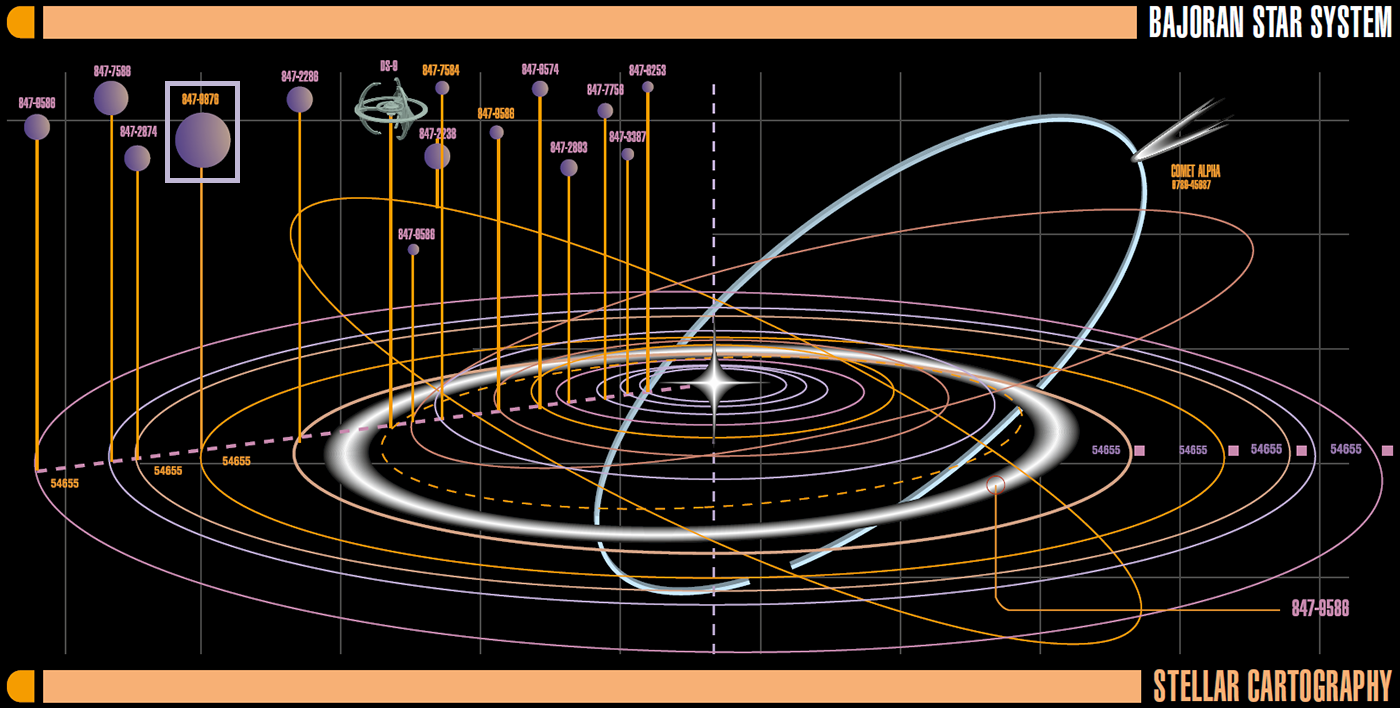
BAJORAN SYSTEM
SYSTEM INFORMATION
- System Name: Bajor
- Traditional Name: B'hava'el
- Location: Alpha Quadrant, Sector 45833 (Bajoran Sector)
- Type: G2V (Yellow Main Sequence)
PLANETS
| Position | Name | Class | Diameter | Density (Composition) | Gravity |
|---|---|---|---|---|---|
| I | Ketrora | B | 3,490 km | 5.6 (Medium Iron) | 0.28g |
| II | Sarus | B | 3,723 km | 5.6 (Medium Iron) | 0.30g |
| III | Ailara | B | 4,654 km | 5.4 (Medium Iron) | 0.36g |
| IV | Choth | B | 5,119 km | 5.5 (Medium Iron) | 0.40g |
| V | Kuyama | D | 4,887 km | 5.3 (Medium Iron) | 0.37g |
| VI | Adorenga | D | 3,956 km | 5.3 (Medium Iron) | 0.30g |
| VII | Cajara | D | 4,189 km | 5.3 (Medium Iron) | 0.32g |
| VIII | Andros | L | 7,214 km | 4.3 (Low Iron) | 0.44g |
| IX | Baseras | D | 3,490 km | 3.2 (Silicate) | 0.16g |
| – | Denorios Belt | – | – | – | – |
| X | Bapira | H | 7,446 km | 3.4 (Low Iron) | 0.36g |
| XI | Bajor | M | 15,358 km | 4.8 (Medium Iron) | 1.05g |
| XII | Ostratus | C | 7,446 km | 3.2 (Silicate) | 0.34g |
| XIII | Ba'Syladon | C | 9,773 km | 3.4 (Low Iron) | 0.47g |
| XIV | Bak'tal | C | 6,981 km | 2.9 (Silicate) | 0.29g |

BAJOR
Traditional Name: BAJOR
- Position in System: XI
- Number of Satellites: 5 (Endalla, Penraddo, Baraddo, Derna, Jeraddo [Class M])
- Mean Density: 4.8 g/cm3
- Mass: 9.10424 x 1024 kg
- Planetary Gravity: 1.05G
- Planetary Size
- Diameter: 15,358 km
- Equatorial Circumference: 48,250 km
- Total Surface Area: 741,001,690 km2
- Percent Land Mass: 42%
- Total Land Area: 311,220,710 km2
- Volume: 1.8967 x 10¹² km3
- Planetary Conditions
- Length of Day: 26 hours
- Length of Year: 0.90 Earth Years
- Atmospheric Density: Standard
- Mean Atmospheric Pressure (sea level): 108.4 KPa (1.07 atm)
- Axial Tilt: 25°
- Seasonal Variation: Moderate
- General Climate: Warm Temperate
- Mean Temperature at 30° Latitude
- Low: 6.7° C
- Average: 21.2° C
- High: 33.6° C
Planetary Profile
Bajor is a lush, green planet with temperatures matching Earth's without scorching summers and frigid winters. Its land was perfect, and weather was perfect for raising crops, and its mountains were rich in ore and minerals. During the Occupation, the Cardassians stripped Bajor of most of its natural resources and left the land barren. While beautiful gardens still grew all over Bajor, kept by the Cardassians who wanted a beautiful view while they occupied the planet, the groomed bits of nature were not enough to support life on the planet. Working together with the Federation, Bajoran scientists toiled tirelessly on jumpstarting their planet's ecosystem before it was too late. These efforts have met with promising success and it seems what Bajor needs most, to become the farming paradise it once was, is time. In the meantime, the people continue to rebuild the infrastructure destroyed during the Occupation.
Bajoran Physiology
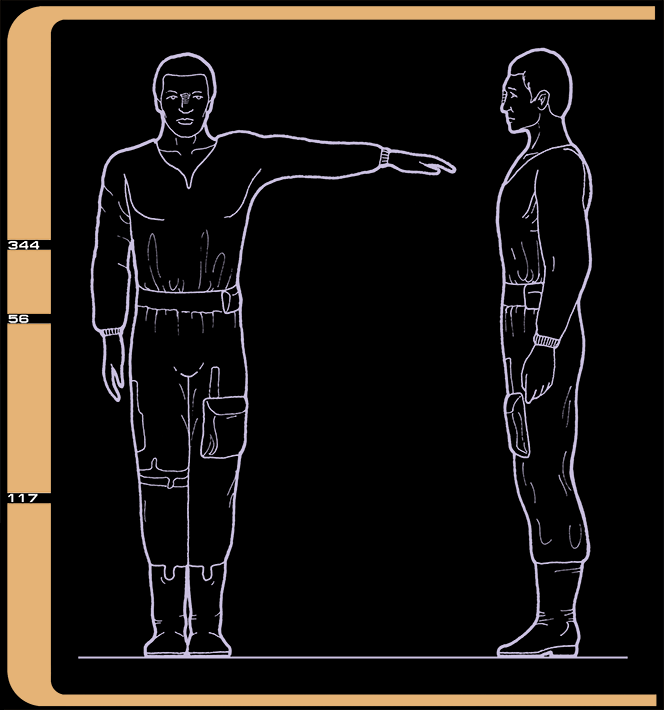
Bajorans are a humanoid species with distinctive raised ridges on their noses. Their skin tones range from a pale crème to dark brown, and their natural hair color is anything from blonde, to brown, and black. Naturally Bajorans live to roughly 120 years, but current census data has the life span of an average Bajoran at 70 years. This census data was taken before the end of the Occupation and numbers are predicted to increase in future census years.
The gestation time for a Bajoran infant is just five months. During Bajoran pregnancy, women experience few side effects, but can experience sneezing fits brought on by the child in their womb. Traditional Bajoran lore says the sneezing is brought on by the child "greeting the Prophets," and sneezing symptoms are minimized with meditation.
Government
During the occupation, the Cardassians installed a puppet regime called the Bajoran Occupational Government. Following their withdrawal from Bajor in 2369, a Provisional Government (later known as the Bajoran Republic) was established, which consisted of Ministers who were organized in the Bajoran Council, the Board of Ministers, the Chamber of Ministers, and the Council of Ministers. Although Bajor maintained a secular government, religious leadership, personified by the Kai as the head of the Vedek Assembly, was also an important aspect of social cohesion on Bajor and, thus, also held great political influence.
The Council of Ministers was comprised of members of well-respected families and war heroes in Bajor. Many of these members were diplomats and played key roles in defeating or undermining Cardassian rule during the Occupation. With the formal establishment of the Bajoran Republic, an electoral system has been put into place and Ministers are elected by each region's populace. The Council of Ministers is led by the First Minister who is considered the leader of the Council. The First Minister does not have last say on what the council decides, but is in charge of getting the council members to agree with one another and to present a unified voice for Bajor. The current First Minister is Shakaar Edon, who has held the post since 2372.
The Vedek Assembly is part of the Bajoran religious faith. During the Occupation some of the Assembly found to be teaching the words of the Prophets were forced to go into hiding and was able to play no hand in Bajoran politics for fear of their own lives. Instead, they worked in secret with the Bajoran underground to ensure that their people did not lose the last remnants of their spirituality. The Vedek Assembly is led by the Kai, who is the head of all religious matters on Bajor. The current Kai is Pralon Onala, who was elected to the post in 2377.

History
Bajorans can trace the history of their civilization back over the course of 30 milliennia, and by the fact of sheer longevity they have experienced almost everything that can happen to an advanced race, both good and bad. They have known periods of global peace and prosperity, periods of chaotic intramural warfare, and periods of just about everything in between. More recently, they have known both brutal occupation by a foreign power, the end of which left them with almost as many problems as their oppressors had inflicted, and spiritual exaltation from the possibility that they had discovered their gods in corporeal form.
The Bajorans developed space travel in the 16th century, using huge yet light craft powered by foil "sails" that caught Bajor-B'hava'el's solar wind. These craft proved surprisingly durable, and archeological evidence found on Cardassia in the 24th century showed that they were even able to make the journey across systems.
In 2328, the Cardassian Union, which had long coveted its uridium-rich neighbor, formally annexed Bajor. After a bloodless invasion (traditionally, the Bajorans maintained only token planetary defenses), Cardassian forces occupied the planet. Over the next four decades, the Cardassians depopulated the planet, sending most of the population into exile. The Bajorans who remained were impressed as laborers, stripping the planet's natural resources for the Cardassians' benefit. Many Bajorans, however, escaped the Cardassian net and fought the occupation guerrilla-style, using sabotage and sneak attacks to make life as miserable as possible for their tormentors. Eventually, it worked. The drain on military resources finally led the Cardassian Central Command to order all Cardassian forces to withdraw in 2369.
Left with the daunting task of rebuilding their society, the Bajoran provisional government turned to the Federation, which had also been the Cardassians' enemy at one time, for economic aid and diplomatic cooperation. The Federation took over a former Cardassian orbiting mining depot and converted it into a Starfleet deep space station, christened Deep Space 9. Almost immediately after Starfleet occupied DS9, the station Science Officer discovered the mouth of a wormhole in the Denorios Belt. Subsequent investigation discovered an advanced alien race living in the wormhole. On Bajor, the vedeks immediately declared that the aliens (whose identity has never been firmly established) must be the Prophets of their religion, and the wormhole the Celestial Temple in which they were said to live.
The discovery of the wormhole and the deep religious significance that they ascribed to it reinvigorated the Bajorans. They used it to send starships into Gamma Quadrant, even setting up the colony of New Bajor near the other end of the wormhole. Their elation did not last long, however. The Bajoran outpost (as well as the presence of Federation starships) drew the attention of the Dominion, the aggressive interstellar empire that controlled much of Gamma Quadrant. In 2371, the Dominion's Jemm'Hadar shock troops destroyed New Bajor as a prelude to invading Alpha Quadrant through the wormhole.
In 2373 the Dominion and their new Cardassian allies captured DS9, formally inaugurating the Dominion War. Powerless to resist an attack without Starfleet's aid, the Bajoran provisional government, reluctantly made a separate peace with the Dominion. Bajor had applied for Federation membership in 2369, and its application was finally accepted in 2373. However, Starfleet Captain Sisko, whom the Bajorans considered a religious figure called the Emissary due to his role in the discovery of the wormhole, acting on strange visions he had experienced since visiting ancient ruins at B'hala, advised the provisional government to withdraw their application. The Federation Council was taken aback by this turnabout, but left their invitation open, and the move proved fortuitous as it permitted Bajor to sign the pact with the Dominion.
With the defeat of the Dominion, Bajor is once again prospering, buoyed by renewed trade through the Wormhole to the Gamma Quadrant and the planet's central role in rebuilding the sector after the Dominion War. Negotiations for Bajor to join the Federation have resumed, but with their current position the Bajoran Government is in no hurry and the process is expected to take several more years at least.
Culture
Bajoran culture has changed much since the Occupation. Before the Cardassian Occupation Bajorans were a peaceful people focused on spirituality and art. Society was split up into d'jarras, different castes a person was born into. A person's d'jarra determined the professions they could take and their social standing. For example, the artists were of a higher d'jarra than soldiers or laborers. When the Cardassians invaded, d'jarras went out of use as everyone banded together to fight. After the Cardassians left, the system no longer worked, because Bajorans were too spread out and adopted many different jobs.
Understanding most things on Bajor comes down to understanding Bajoran spirituality and religion. They believe much in the universe is connected to an energy called pagh and that most things happen for a reason. The Prophets, who lived in the Celestial Temple, gave pagh to the universe and replenish its energy from their home. The pagh is the spiritual force inside a person, a 'soul.' Each individual person's pagh is unique, it carries their experiences, intentions, and wishes for a future. It is possible for a person to become detached from their pagh if they ignore it and most Bajorans seek to gain a harmonious balance with the force within them.
The Prophets are Bajoran deities who watch over the ebb and flow of the pagh in the universe. They are benevolent beings who exist beyond mortal knowledge, but who see fit to guide the Bajoran people who worship them. Thousands of years ago the Prophets gifted the Bajorans with nine Orbs, the Tears of the Prophets, which granted the Bajorans who viewed them with enlightenment. The Orbs contained volumes of enlightenment from the Prophets intended for the Bajoran people and each Orb relayed a different type of information. During the Occupation, the Cardassians seized eight out of the nine Orbs sending them offworld. Only one Orb remained on Bajor – the Orb of Prophecy and Change. Anyone who views the Orb is able to see a deeper meaning within their own life. It is not to say the person will understand this deeper meaning, but only that they will know what is to come, or have a light shown on what has already come to pass. In recent years, we've come to understand the Prophets and the aliens who live in the Bajoran wormhole to be one and the same. Rather than an invisible Celestial Temple in the sky, the Prophets call the wormhole home. This fact has done nothing to dissuade the Bajoran people of the Prophets' divinity, but rather affirmed their beliefs and understanding of how the universe works.
Aside from spirituality, family is the single most important thing to a Bajoran. Because of the strength a Bajoran family has, many were split up during the war. Spouses were killed, siblings sent to different work camps, and important family lines broken apart. Families are only now starting to find one another again, estranged over different planets in the system. On worlds where families managed to stay together, a person's name is everything. The family they come from tells others the type of person they are, whether they are to be trusted, and what their family did for the Bajoran Resistance.
In the traditional form of address, Bajorans place their family names before their given names.