The Triangle
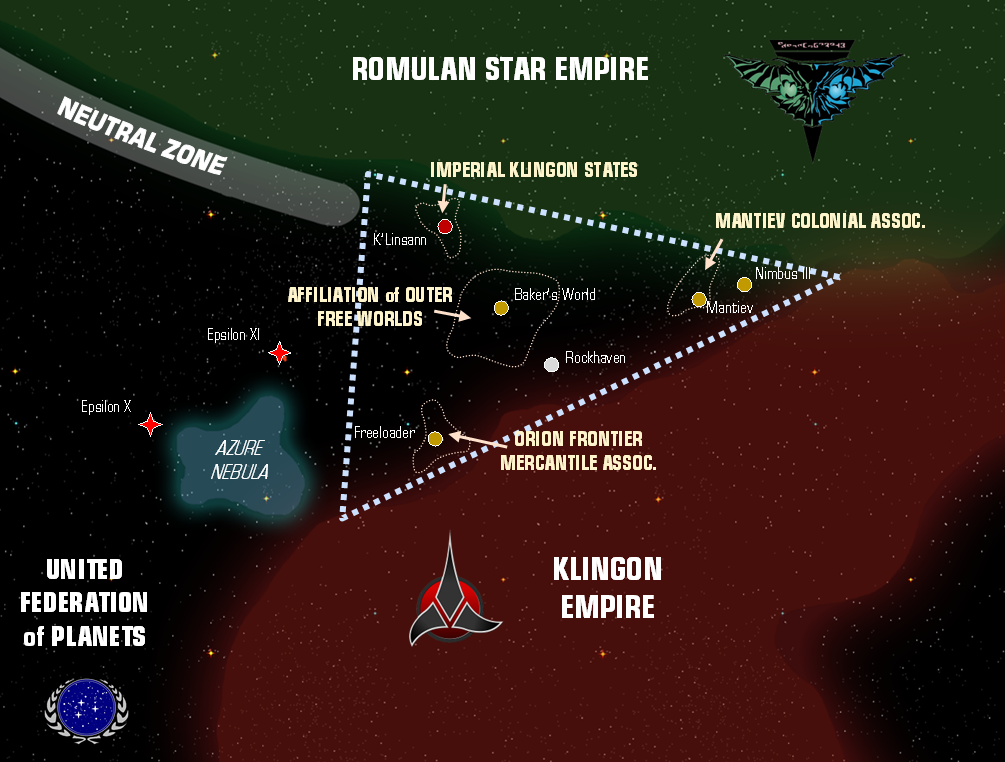
The Triangle sector is a region of space where the United Federation of Planets, Klingon Empire, and Romulan Star Empire spheres of influence meet. The name derives from two-dimensional star chart representations of the sector, where the borders of the three stellar powers form the edges of an irregular triangular shape. In a more accurate, three-dimensional representation the region appears as a form of irregular conic or pyramidal shape, but nonetheless the Triangle name has stuck.
None of the major powers controls the Triangle sector outright, rather each makes efforts to influence the handful of multi-system governments and numerous independent worlds to gain an advantage over the others. In reality, it is likely the Orions who wield the most influence, as they control the majority of the legitimate, and illegitimate, trade between the worlds of the Triangle and the major powers that form its borders.
POLITICAL MAP
HISTORY
The Romulan Star Empire was the first government to establish any settlements in the region of space now known as the Triangle. Expansion into the area two centuries ago brought the Romulans into conflict with the expanding Klingon Empire, leading to both powers generally ignoring the Triangle region as the confrontations between the two focused on the rimward corners of their territories. During the Earth-Romulan War the region was the site of several battles, but afterward the two governments focused on the regions along the shared border and the newly established Neutral Zone.
With Earth and its allies in the newly formed United Federation of Planets focused on the Alpha Quadrant, the Klingons dealing with internal issues, and the Romulans licking their wounds from the War, it was individual interests that began to take notice of the Triangle. Individuals leery of this new Federation, groups fleeing real or perceived persecution, fugitives, dissatisfied and displaced persons, and those who simply wanted to be left alone became the first pioneers to establish settlements in this new era of the Triangle.
In the remote Triangle region supplies for these new colonies were hard to come by. The Orions saw an opportunity and were willing to take some initial losses to establish trade relations with these new worlds. The gamble paid off as the settlements matured and began to exploit the resources of their new homes. By this time the Orion trade routes were well established within the Triangle. The lucrative trade of course attracted those who prey on such riches, bringing pirates and smugglers to the area. Soon there was a thriving black market running alongside the legitimate trade, sometimes both operating out of the same spaceports with little to distinguish the two.
It was not until the Federation-Klingon War that the major powers started to take real notice of what was happening in the Triangle. As with the Earth-Romulan War a century earlier, the region became the site of battles between the belligerents in the conflict. Unlike before, however, there was now an established population in the area. The Orions and the independent worlds were ready to assert their own claims and positions. The Federation could not afford to antagonize the colony worlds they now needed as bases of operation, and were willing to provide funding, supplies and protection to keep those worlds from Klingon control. For their part, the Klingons realized they could not attack any Triangle worlds without risking unifying the rest of the region to side with the Federation. Thus it was in their interest to recognize the independence of these worlds. The Orion government, facing possible sanctions for openly trading with the Klingons in the Triangle, had their groups in the Triangle officially secede from Orion and form their own independent association. Thus the Orions could continue to trade with both the Federation and the Klingons in the Triangle without threatening Orion interests in the Alpha Quadrant.
The end of the first Federation-Klingon War saw another wave of colonial efforts in the Triangle, with the Orions and the already established colonies happy to provide support to the newcomers. This allowed these new colonies to establish themselves more quickly, leading to a new trade boom in the region. The three major powers that abut the Triangle all came to realize that conquest of the region was not feasible. This meant their military efforts ended with the bases and outposts that form their unofficial borders with the Triangle, and resulted in a market where anyone could make their fortune, or lose it. The Orions had a head start, necessitating that the Federation, Klingons, and Romulans play catch-up.
The Triangle's population grew swiftly in the latter half of the 23rd Century. With several dozen planets settled, the most desirable real estate was already in someone else's possession. A few small multi-system governments formed and managed to thrive in the shadow of the three major powers. The Triangle became one of the last refuges where fortune hunters and adventurers, and others who value their independence, could thrive.
The shifting fortunes of the Federation, Klingons, and Romulans during the 24th Century ultimately had little effect on the Triangle at large as the three powers have generally chosen to ignore the region. Even the Dominion War did not really impact the region. The biggest change has been to the level of Orion influence in the Triangle; after almost a century of having a stranglehold on trade between the worlds of the region the Orions are now facing serious competition from the Ferengi.
TIMELINE
- 2156-2160 - Earth-Romulan War
- 2161 - Mantiev is settled
- 2176 - Mantiev Colonial Association formed
- 2191 - First major wave of Triangle settlements begins
- 2202 - Freeloader, the first major Orion tradeworld in the Triangle, is settled
- 2204 - Baker's World colony founded
- 2256-57 - Federation-Klingon War
- 2256 - Orion Frontier Merchants Association declares independence from the Orion homeworlds in a move to allow them to trade with both the Klingons and Federation
- 2257 - Affiliation of Outer Free Worlds founded with agreements signed on Baker's World
- 2258 - Imperial Klingon States formed when Admiral K'mto flees with a loyal force after a failed coup attempt against Chancellor L'rell
- 2260 - Penchan II becomes the fourth member of the IKS. The planet is vital as a source of dilithium and other valuable minerals and metals, allowing the IKS to start rebuilding its worn-out fleet
- 2267 - Nimbus III established after the Treaty of Organia ends the second Federation-Klingon War
- 2275 - Civil War erupts among the members of the Mantiev Colonial Association
- 2287 - Terrorists take control of the capital of Nimbus III and hold the Federation, Klingon, and Romulan ambassadors hostage.
- 2293 - A surge of disgruntled Klingons joining the IKS follows the signing of the Khitomer Accords.
- 2995 - Mantiev Civil War ends with the defeat of the rebels.
- 2311 - Romulan Star Empire abandons its overt presence in the Triangle.
- 2318 - IKS loses two battleships in an encounter with the USS Enterprise-B, severely reducing the effectiveness of its starship forces.
- 2334 - Internal strife erupts into a brief open conflict between the major families in the Orion Frontier Mercantile Association.
- 2356 - Romulan Star Empire covertly establishes a new major colony on Nimbus III
GOVERNMENTS
Major Powers
Multi-System Governments
- Affiliation of Outer Free Worlds
- Orion Frontier Mercantile Association
- Imperial Klingon States
- Mantiev Colonial Association
Independent Worlds
Major Powers
United Federation of Planets
The UFP focuses mostly on patrolling its own boundary with the Triangle sector, offering protection to not only the Federation colonies and member worlds that fall within the Triangle but also any independent worlds that lie within the boundary. Federation efforts are primarily diplomatic, focusing on convincing independent worlds of the benefits of Federation membership, in addition to forming trade relations with the various worlds within the Triangle. Militarily, the Federation tends to keep Starfleet on its side of the boundary with the Triangle, though a handful of small patrol craft as well as scouts and science vessels can sometimes be found deeper in the sector.
Klingon Empire
The Klingon Empire was the most expansionist of the three major powers when it came to the Triangle sector in the 23rd Century. The Klingons focused on acquisition of new worlds within and outside their sphere of control and maintained strict trade policies within their boundaries, carefully vetting any independent traders that wanted to operate there. After the Praxis explosion and the Khitomer Accords, the Empire greatly reduced its presence in the Triangle and has only turned its attention back to the region in the last few decades.
Romulan Star Empire
The Romulan Star Empire's boundary with the Triangle is the most thinly populated of the three powers, mostly due to the century of seclusion of the Empire in the aftermath of the Earth-Romulan War and the later decades of removal from galactic affairs following the Tomed Incident. Romulan policy in the Triangle was mainly concerned with defense of their border and has only recently turned towards a more economic and colonial expansion into the area
Multi-System Governments
Affiliation of Outer Free Worlds
The Affiliation of Outer Free Worlds (AOFW) is the largest of the multi-system independent governments in the Triangle sector. The AOFW was formed at the start of the Federation-Klingon War as a means of mutual protection when the war front reached the Triangle. At the heart of the organization is the Baker's World colony, founded at the start of the 23rd Century by Leland Baker, son of an Earth-Romulan War veteran who had discovered that world during the war. The Baker Family remains highly influential in the AOFW, with Everett Baker, great-grandson of Leland Baker, leading the effort to unify the member worlds in the first place. His son, Willis Baker, is the current head of the Grand Council of the Affiliation as well as head of the Baker's World. So central to the AOFW is the family that the Affiliation is frequently referred to as the Baker's Dozen.
The AOFW allied with the Federation during the war with the Klingons, offering shipyards and refueling facilities, but after the war they retained their staunch independence, no longer allowing Starfleet military vessels in their territory. The Federation was too concerned with rebuilding after the war to push the matter, so the Affiliation remained independent. The Affiliation is primarily a mutual defense pact, and today the AOFW fields modest space and ground forces.
Orion Frontier Mercantile Association
The OFMA was born out of necessity during the first Federation-Klingon War. When the war broke out the Orion Syndicates came under pressure from the Federation to end, so to not lose the Klingon trade the Orion colonies in the Triangle declared themselves independent of the Orion government. The Federation saw through the gambit, and in turn forced the Orions to cut any support from the newly formed Orion Frontier Mercantile Association.
As a result, the OFMA had to effectively rebuild their trade network in the Triangle from scratch, a setback that allowed other worlds in the sector, like Baker's World, to catch up and present real competition. Over the subsequent decades, however, the OFMA was able to make up for lost time and by the start of the 24th Century they dominated trade in the region. This has begun to change in the last decade, however, as the Ferengi have started to make serious inroads in the Triangle.
Imperial Klingon States
The IKS was formed in the aftermath of the Federation-Klingon War as a result of Admiral K'mto's attempted coup against new Chancellor L'rell. K'mto counted on L'rell to have a weakened position given how she ascended to her position. Unfortunately for the Admiral, L'rell had anticipated such opposition and was prepared for the coup attempt. K'mto may have miscalculated his odds, but he was not a fool. When it became apparent the coup would fail, K'mto retreated to the Triangle sector with his remaining loyal forces.
K'mto's scouts identified a small Human colony near the Romulan border as an ideal target. The colony was independent, so K'mto did not need to fear Federation retaliation. K'mto had hoped to use the Human population as slave labor to mine the planet's resources, but they turned out to be hardened idealists who chose mass suicide rather than enslavement. The Admiral was forced to put two thirds of his troops to work in the fields and mines of the world he renamed K'linsaan.
Even with this, K'mto soon set his eyes on expanding his new "empire". Despite caution from his staff, K'mto sent his meager forces to take control of a nearby uninhabited world. This was not enough for K'mto and he wanted to move quickly, consolidating other opposition groups to make another coup attempt, and inaugurating the Imperial Klingon States as what he claimed to be the true Klingon Empire. This time the resistance from the others went a bit further, and by the time the dust settled K'mto and several others were dead and the newly-formed IKS had a new leader, Kepel, who had been K'mto's latest Chief of Staff (the previous having been executed by the Admiral for opposing his plans).
Under Kempel the IKS took a more conservative approach, but still expanded. Kempel's focus was on resources and ship repair capability, and with his leadership the IKS managed to rebuild its fleet sufficiently that by the time the Federation learned of their existence an attack would not be feasible. Since then the IKS has slowly consolidated its power and solidified its presence in the Triangle. Kempel is maintaining a slow but steady rate of expansion and building up his armed forces.
This slow approach let the IKS slowly build up its forces, and they gained a surge of new recruits in the 2290s and early 2300s as Klingons disgruntled with the new alliance between the Empire and the Federation fled to the Triangle to join the so-called "true" Klingon Empire. Many of these newcomers also brought their warships, further bolstering the IKS naval forces. This growth ended abruptly in 2318 when a space battle ensued between IKS ships and a squadron of Romulan vessels. Also involved was the USS Enterprise-B and the battle went poorly for the IKS, resulting in the loss of a significant number of ships. This effectively ended the IKS as a major threat in the region and since then the rebel government has had to focus mainly on holding onto its existing territories.
Mantiev Colonial Association
The Mantiev Colonial Association is the oldest multi-system government in the Triangle, being almost 200 years old. The Mantiev colony was established the same year that the Federation was formed and joined with three other early colonies to form the MCA before the end of the 22nd Century. The member worlds maintained strong independence, but still held together in a strong sense of strength through alliance against encroachment from the major powers surrounding the Triangle. This strong unity has now ended, with the political leadership from Chaniviev tiring of what they saw was selfish dominance by the Mantiev colony and seceding. This split the MCA in two, leading to a civil war. While the Federation attempted to mediate between the two sides, the Klingons and Romulans backed the rebel Chaniviev and loyalist Mantiev sides respectively. The conflict lasted for two decades, before the Klingons had to withdraw their support to focus on recovery after the Praxis disaster and the Romulan-backed loyalist forces emerged victorious. The Mantiev government still remains in power, despite reduced Romulan support following the Tomed Incident.
Independent Worlds
These are only a few of the dozens of independent worlds in the Triangle sector.
Nimbus III
In 2267, following the second Federation-Klingon War, an agreement was reached between the Federation, Klingon, and Romulan governments to mutually develop the planet of Nimbus III in the Triangle sector in the hopes it would serve as a model for peaceful coexistence. Nimbus III was advertised as the “Planet of Galactic Peace” to encourage immigration, but in reality the planet is a desert world and most of the colonists wound up being fugitives or those desperate enough to relocate to the remote worlds. While the three powers maintain a token ambassadorial presence, they have no military forces on Nimbus III. To maintain peace the planetary government, ruling from the planet's only real settlement, Paradise City, have banned weapons from the populace. This didn't stop violence from frequently erupting between residents using crude, homemade weapons.
The three powers made a token effort to fulfill the promise of the planet following a terrorist incident in 2387 this fell short and by the end of the 23rd Century all three governments had abandoned the project and planet, leaving the remaining inhabitants to fend for themselves. The Romulans began a covert colonization effort on the planet in the mid-24th Century, headed by the Tal Shiar, which the other powers only learned about just prior to the outbreak of the Dominion War. Now that the war has ended the Federation has belatedly turned its attention back to the "Planet of Galactic Peace".
Aarris
Aarris is a Human colony on a mineral rich world located in the narrow strip between the Klingon and Romulan Empires at the far end of the Triangle sector. The colony has managed to stay independent by playing the two powers against each other, freely trading with both sides. Both the Klingons and the Romulans maintain embassies on the planet and keep military forces nearby in case the other should try and make a move to capture Aarris and its rich resources for themselves.
Freeman's Port
This world is one large merchant bazaar. The black market is also quite sizable and well-stocked. Though located near Romulan space, the Romulans have been more focused on nearby Mantiev space and don't have the resources to spare to take control of Freeman's Port. This, coupled with the Freemen's negotiating skills have helped maintain the world's independence.
Flood
The aptly named Flood is a water world whose small land masses are constantly inundated by the massive tides caused by the planet's two moons. This and the unpredictable weather led to most of the colony's cities being established underwater, with the few surface cities located on the highest plateaus that are safe from the flooding. The main exports are minerals and radioactives, extracted from the sea floor. While independent, Flood tends to maintain decent relations with the Klingons due to the world's proximity to their space.
Rockhaven
Rockhaven is a cool, barren, mountainous world that is also very rich in ores and minerals. The planet is known as one of the few sources of Timilite, a mineral used in the manufacture of complex hydrocarbons including those that form the basis of many of the Federation's advanced medicines. The Rockhaven government established a close relationship with the nearby Affiliation of Outer Free Worlds, for both the access to trade routes and for potential support should the Klingons have threatened to make a move on the planet for its resources. While the Klingon threat has abated, the planet maintains its close relationship with the AOFW.
Lanroche VIII
Lanroche VIII is a tradeworld located at the midpoint between the Orion Frontier Mercantile Association and the Affiliation of Outer Free Worlds territory. Virtually anything is available in the planet's markets for the right price if it is legal, or in the extensive black market if it is not. Early on the Lanroche system was a tempting target for pirates, but their activities eventually attracted enough bounty hunters seeking to claim the price on the heads of the pirates that now they avoid the system. Today there are still dozens of bounty hunters calling Lanroche home, helping keep the traders honest.