Astrometrics
When it comes to describing the position of the starship, or of a target star, planet, spacecraft or other object; there are generally two options. For nearby targets, a relative position is generally more useful, while for more distant targets it makes more sense to refer to the location in terms of an absolute position according to standard star charts.
Relative Position
The position of a star, planet, or other object can be described in relation to the observing starship. A precise method of such relative position notation parallels the relative bearing method of navigation, where an azimuth/elevation direction to the target relative to the current orientation of the spacecraft is specified along with a distance.
A more general method of describing the position of a target object is to describe the target's location relative to the center of the galaxy compared to the spacecraft's current location. Much as on a planetary surface with a cartesian mapping system a target can be described as being North, South, East or West of the observer; a target in space can be described as coreward, lying between the observer and the galactic core; rimward, between the observer and the rim of the galaxy; spinward, away from the observer in the direction of rotation of the galactic disk; or antispinward, away from the observer in the direction opposite of the rotation of the galactic disk. The target can also be described as above or below the observing spacecraft, where the galactic "up" and "down" are defined based on a clockwise direction of spin for the galaxy.

Star Charts
For general stellar mapping purposes, the Milky Way Galaxy is commonly divided into four equally sized, cubic quadrants, defined by one meridian passing through the galactic core and a second one perpendicular to the first, that also passes through the galactic core. These four quadrants are referred to as the Alpha Quadrant, Beta Quadrant, Gamma Quadrant and Delta Quadrant. The United Federation of Planets and its neighboring powers, including the Klingon and Romulan Empires, are located in the Alpha and Beta Quadrants, whereas the Borg Collective is located in the Delta Quadrant, and the Dominion in the Gamma Quadrant.
For more granular charting purposes, the Milky Way Galaxy is further divided into subquadrants and sector zones. The subquadrants are 36 wedge-shaped slices of the galactic disk, each one 50,000 light-years long, 3,600 light-years high, and 8,727 light-years wide at its widest point, representing a 10° arc of the galaxy. The sector zones are a set of 10 concentric circles each 5,000 light-years wide and 3,600 light-years high centered on the galactic core.

The Sector Designation System
In stellar cartography, a sector, which is also referred to as a star sector or space sector, is a gridded region within the Milky Way Galaxy. Sectors are composed of an area and volume encompassing several light years and typically contain several star systems. The United Federation of Planets, and as such Starfleet, uses a stellar cartographic system that divides the Galaxy into roughly equal size cubic regions, using these as the formal definition of sectors. The UFP utilizes a hierarchical, position-based naming standard to assign a unique identifier to each of these sectors. This identifier is referred to as the Sector Designation.
The first digit or letter (0-9, A-Z) in the sector designation refers to the SUBQUADRANT of the galaxy that the sector is located in while the second digit (0-9) refers to the SECTOR ZONE. Together these define the sector grid, the highest level of the hierarchy in the sector designation.
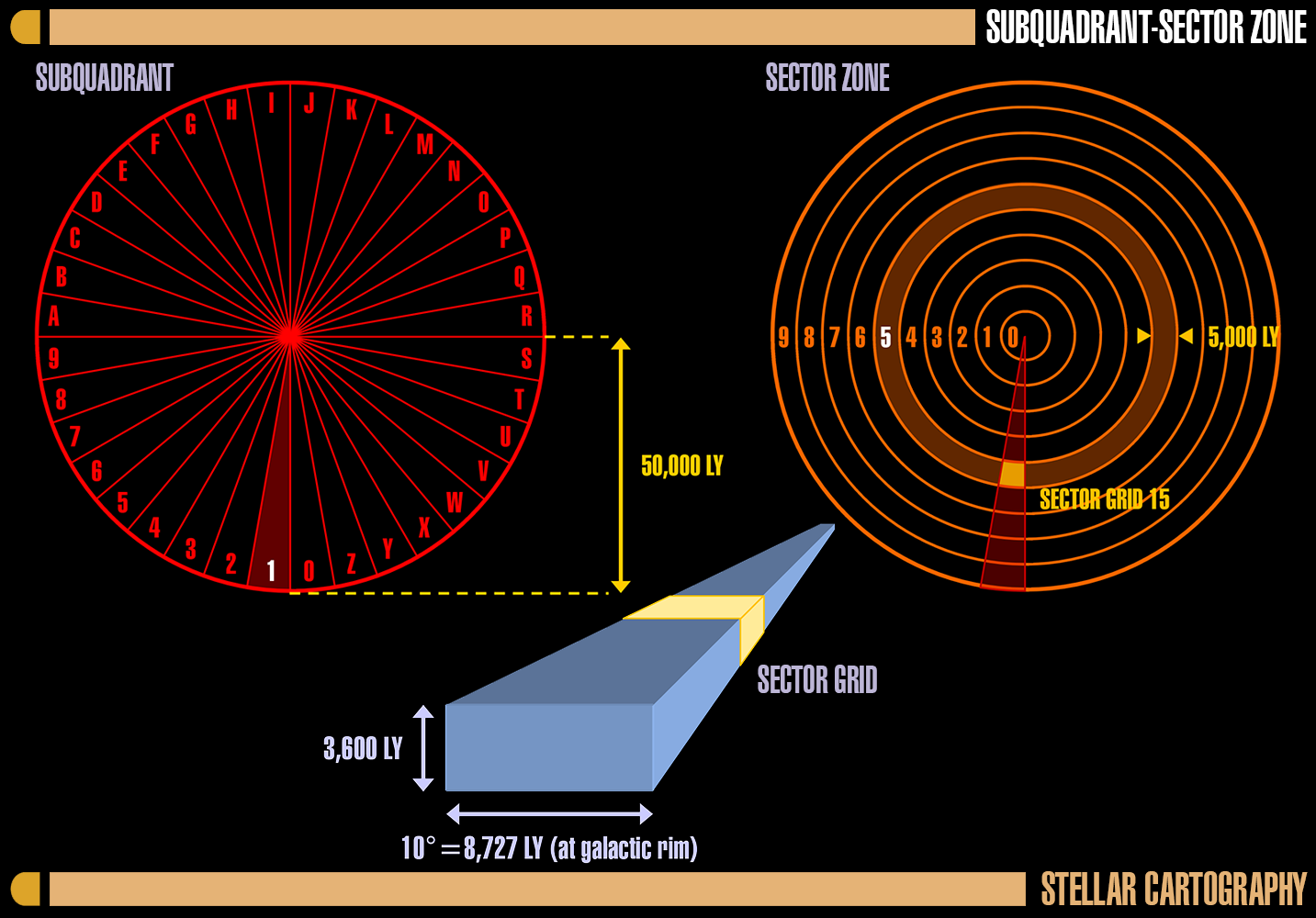
The full sector designation for a specific space sector can be broken down into the following component parts. The Sector Naming convention is discussed at the end of the breakdown.
The following descriptions use Sector 150207612 as an example for the sector designation, which can be broken down as follows:
| Grid | Quad | Block | Sector |
|---|---|---|---|
| 15 | 02 | 076 | 12 |
Sector Grid
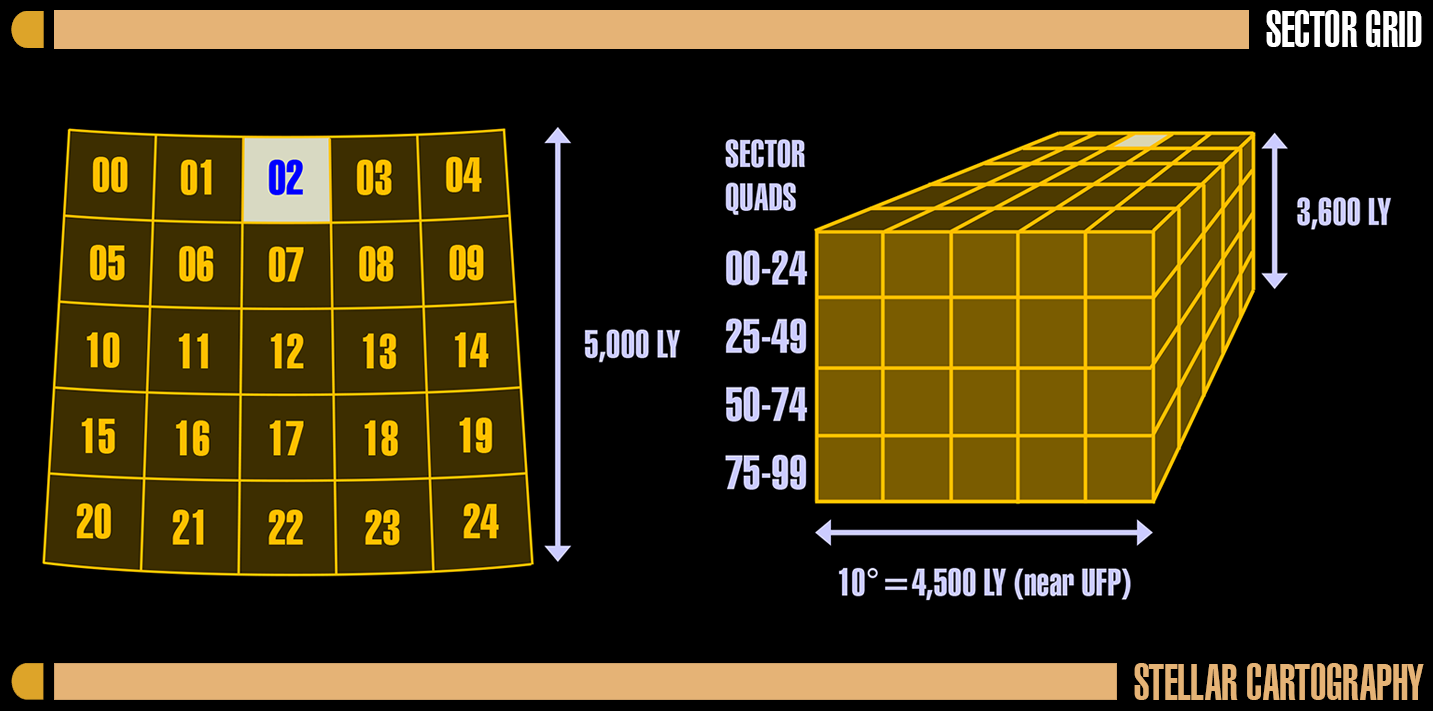
Each intersection of a subquadrant and sector zone is a Sector Grid 5,000 light-years long by 3,600 light-years high (for instance, sector grid 15 is the intersection of subquadrant 1 and sector zone 5). The width of a sector grid depends on its distance from the galactic core; near the UFP, a sector grid is approximately 4,500 light-years wide at its widest point.
Sector grids are divided into 100 SECTOR QUADS of equal volume, which are numbered 00 through 99; these represent the third and fourth digits in the sector designation (prior to the mid-24th Century, sector quads were commonly, though mistakenly, referred to as "quadrants"). Note that closer to the galactic center, sector quads will resemble wedges rather than cubes, and the further from the center of the Galaxy, the large the volume of space contained in each sector quad.
Sector Quad
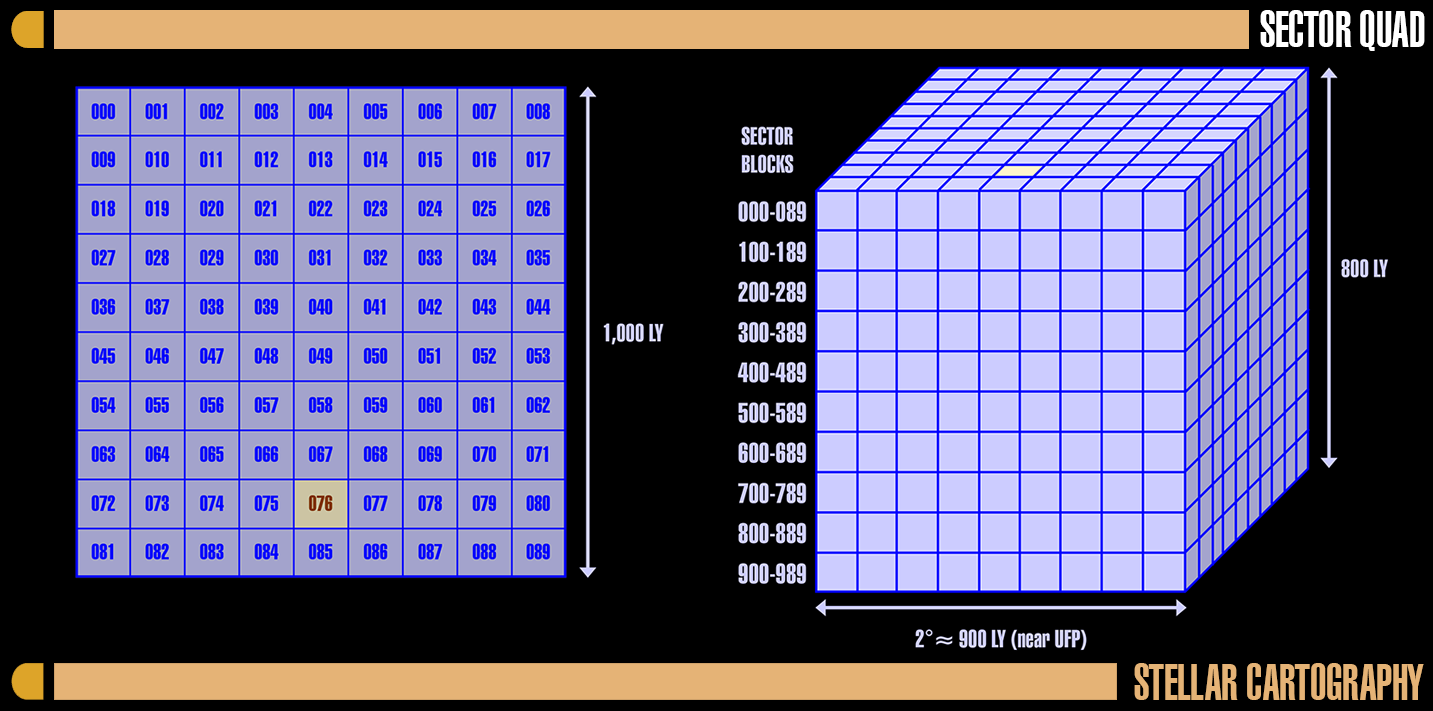
Each sector quad is divided into 900 or more roughly cubical SECTOR BLOCKS (also known as "Sectors" with a capital "S"). The next three digits in the sector designation (000-999) represent the number of this sector block. Near the UFP, sector blocks are exactly 100 light-years long by approximately 100 light-years wide, with a height of exactly 80 light-years. Sector blocks are laid out in a 9 x 10 x 10 grid instead of a 10 x 10 x 10 grid so that the resulting sectors will be as close to perfect 20-light-year cubes as possible; further out from the galactic core, the width of a sector quad increases from 9 sector blocks to 10 or more.
Sector Block
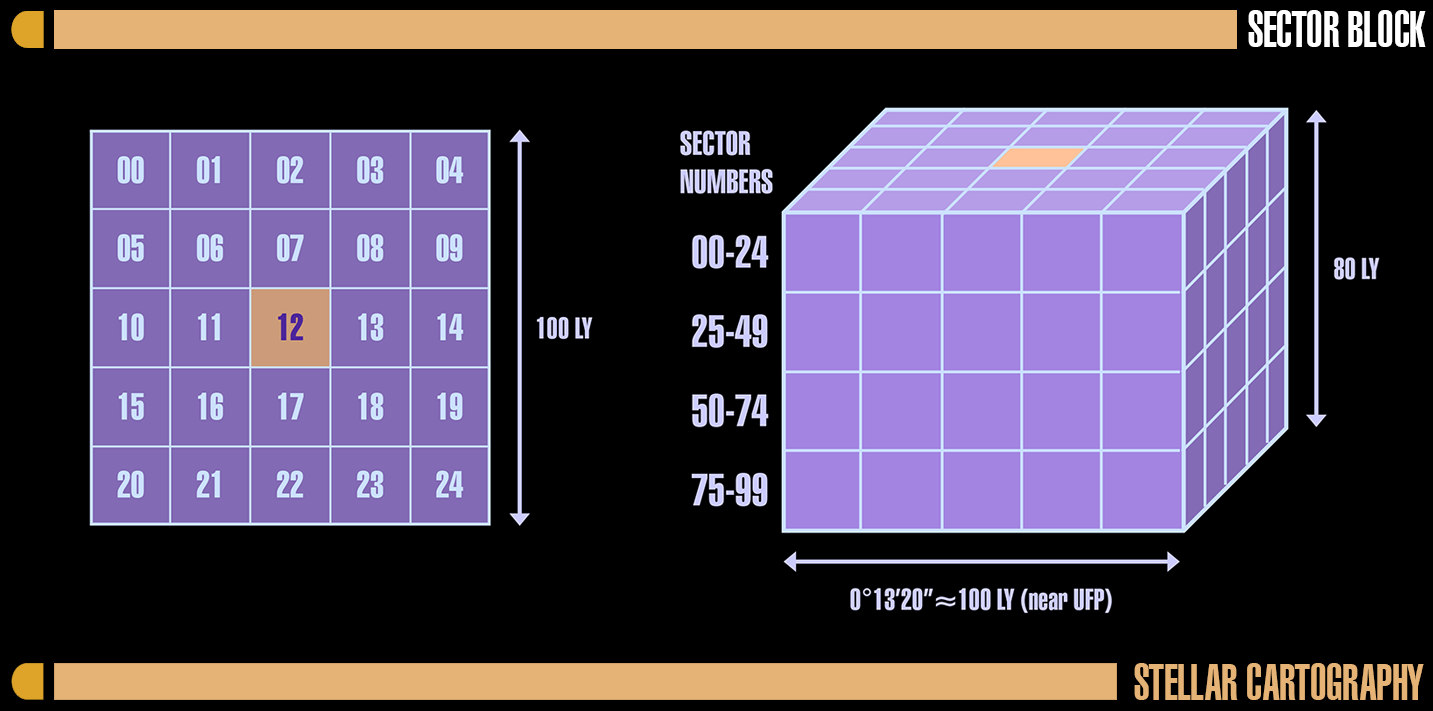
Finally, each sector block is divided into 100 sectors proper, each exactly 20 light-years long by exactly 20 light-years high by approximately 20-light years wide. The sector number (00-99) represents the final two digits of the sector designation.
Near the UFP, the sectors resemble perfect cubes 20 light-years on each side, with the slight curvature all but invisible due to the Galaxy's immense size. Typically, a sector contains approximately 40 stars, about two-thirds of which are members of a binary, trinary, or quaternary system. However, in dense globular star clusters, a sector may contain as many as several thousand stars, and in the void between the spiral arms, sectors may contain no stars at all.
Sector
Since the vast majority of explored sectors are contained in the sector grids bordering the UFP, the sector grid designation (for instance, "15") is often omitted. In fact, in common usage, it is not unusual to refer to a sector by its last five digits ("sector 07612") or even its last two digits ("sector 12"). Given this numbering system, the last five digits of a sector designation will always be unique for a distance of at least 800 light years in any direction, and the last two digits will always be unique for a distance of at least 80 light years.

Sector Names
Populated or otherwise notable sectors are often referred to by the name of an important star system or planet in the sector, such as the Sol Sector, Vulcan Sector, or Bajoran Sector. Sectors can also be referred to by the name of a well-known stellar phenomena in the region, such as with the Mutara Sector.
By convention, the Sol Sector is known as Sector 001; this designation has no relation to the overall sector designation system, but merely indicates that this was the first sector explored by Earth's space vessels. Nearby sectors similarly retain a traditional sector name based on the order in which they were explored, beginning with Alpha Centauri Sector (Sector 002).
Subsectors
For a more exact position, a subsector value can be added to the sector designation or sector name of the described sector. This is generally a 3-, 4-, or 5-digit number assigned to one of a set of equal subdivisions of the sector as measured in parsecs, light-years, or half-light-years. Any greater level of granularity becomes subject to margins of error due to stellar drift and the localized curvature of space-time and so is generally not recommended when specifying an absolute position in stellar cartography.